Posts Tagged ‘Burgundy’

Highs and lows in Burgundy

The birthday boy’s choice for this month’s themed Bring a Bottle club was Burgundy (good choice!), with a stipulation for more reds than whites. That is in fact how it worked out but not always for the best of reasons. 

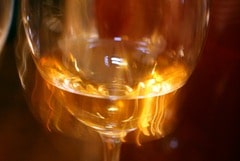
Chablis with that X factorEven if the wine is off it can serve some photographic purpose.  Sadly two of the five whites were either very oxidised (Chablis 2000, Emanuel Dampt) or just oxidised, the latter a real loss: Meursault, Les Forges Dessus, Domaine Prieur-Brunet 1996.  The photograph too was a mistake but a rather happier slip of the hand. 
Petit Chablis, Cuvée Special Juliette Anaïs, Patrick Piuze, 2010 was in much ruder health:  obviously young and fresh, tart apple and lemon sherbet, we all agreed that it is a remarkably good wine for its humble appellation. The Puize label now has quite a following in this part of north Hampshire courtesy of Caviste.  The second bottle is also available locally: IMG_1572Macon-Cruzilles, Clos des vignes du Mayne, Aragonite, 2009. Some of us had tasted this before as it is supplied by Grape Expectations and very good it is too. On this bottle the oak was not as evident as a few months ago, rather it was showing attractive stewed apple notes, some creaminess and mild oak.  The final white was a class act with honeyed, gooseberry and even some exotic fruit aromas, good oak and mineral notes, complex, fine and long.  On this occasion the appellation lived up to its name:  Puligny-Montrachet, Moret-Nominé, 2006.


The evening’s reds were an excellent line-up and some quite venerable:

Nuits-Saint-Georges, Mommessin, 1993

Hospices de Beaune, Premier Cru Guigone de Salins, 2002

Gevrey-Chambertin Premier Cru Les Cazetiers, Vallet Frères, 2000

Chambolle-Musigny, La Combe d’Orveaux, Jean Grivot, 2005

Aloxe-Corton, Premier Cru Les Chaillots, Louis Latour, 1996

Auxey-Duresses, Terre des Velle, 2009

The 1993 was doing pretty well, managing to combine a blue cheese or germolene aroma with pure raspberry fruit, but it was rather drying out and tough on the palate.  The 2002 was a beautifully velvet Pinot Noir, with some ageing notes and some weight, probably at its peak.  There was further development on the 2000, the best of the older wines, with lovely old fruit and that velvet texture again.  The 1996 started off in dusty and wet cardboard mode but then recovered itself, with some fruit but it was fading with noticeable drying IMG_1599tannins.  Of the younger wines the 2005 shone with its lively raspberry and strawberry flavours, subtle and perfumed if still structured and tannic.  And the 2009 was young and fruity as it should be with a whiff of gun powder and toasty oak, even marzipan.  Evidently there were far more highs than lows in the red wines.

Burgundy not being noted for its sweet wines, the final offering was an excellent Vin Doux Naturels but far out of region: Grand Reserve, Rivesaltes, Les Vignerons de Terrats, 1974 – not quite the year we were celebrating but a good approximation!  And the wine was charming and subtle as the celebrand:  sweet caramel, raisins, orange peel and a fine sweetness with smooth alcohol.  Special birthdays are something to celebrate!

IMG_1555

Burgundy 2010 – a first view

Burgundy en primeur week in London gives a chance to taste the 16 month-old wines which have been bottled specially for this purpose – see the previous post; this post focuses on the wines.  As Burgundy is a relatively northern location for wine growing, there is  big vintage variation due to the weather conditions in individual years.  2009 and 2010 are perfect examples.  2009 was warm and even for the grower – which meant good quality grapes and lots of them.  2010 was quite different.  The year opened with a cool and wet spring which meant that the flowering and later fruit set were poor, leading to lower yields.  Summer was no great shakes either.  The season was saved (which happens quite often) by three great  weeks in September, including some summer like days.  The overall result was that good wines could be made by good growers/ winemakers but yields were down, between 10% and 50% down depending on which grower you talked to.  Domaine Marquis d’Angerville reported that while they would crop at 40 hectolitres per hectare in a good year, in 2010 they only made 20 hl/ha.  That is an extreme example but it shows the problem – both for the grower and, inevitably, for the consumer in terms of higher prices. 

In a cool year you would expect the white wines to shine – and indeed they do. This piece will pick out some wines from two very impressive tastings at Lea & Sandeman (LS) and Corney and Barrow (CB) – we only like the very best on this website.  (Actually, on a serious note, it is a shame that the Burgundy growers association did not put on their  usual mammoth tasting as that gives you a great snapshot of the general state of the vintage.  The BIVB is promising ‘something better’ than the usual tasting next year.)  For some wines below, I have put in in-bond prices to give an idea of rough pricing levels. 

IMG_0014

Domaine Moreau-Naudet (LS)

I love this great value Chablis and it is not just the striking label – I can’t decide whether the drawing is of a hand rising out of the vineyard with a nugget of gold or a piece of the precious earth.  In the end it comes to much the same. 

Of the seven wines tasted I would pick out:

Chablis – there is also a Petit Chablis but otherwise this is the basic wine and very good it is too. Characteristic fresh green apple fruit and typical minerality, good concentration and only  £90 a case in bond (add £22 per case excise duty and then 20% VAT on the total = £134, ie just under £11.20 per bottle).  The freshness of the vintage shines through this entry level Chablis. 

Chablis Vaillons Premier Cru – much broader on the palate, substantial minerality, very long; classic quality Chablis

Chablis Valmur Grand Cru – one for keeping of course but great mineral notes, many years of potential ahead but it should retain the raciness which is the hallmark of Chablis.

Domaine Pierre Labet (CB)

Much further south on the Côte d’Or, Labet produces high quality Meursault, other whites and, from other appellations, reds.

Bourgogne Blanc Vielles Vignes – rounder, riper fruit, with fine acidity, slightly drying oak evident at the moment (and most drinkers are not going to keep this long),

Meursault Les Tillets – juicy palate, very youthful, excellent fruit, pleasant whiff of oak, good persistence

Savigny Premier Cru Vergellesses – a different flavour profile, ripe apple and some stone fruit (peach), refreshing acidity, needs time to develop but very good

Moving to the reds:

Beaune – elegant red fruit, lovely acidity, surprisingly drinkable now but enough structure to develop

Gevrey-Chambertin – superb fresh red fruit, beautiful lines – something about the way that the fruit is followed by the acidity and then the tannic rasp, quite lively tannins

Beaune Premier Cru Coucherias – a more lifted bouquet, then refined fruit, superb

Domaine de l’Arlot (CB)

IMG_0011

In a rather different style, the wines of this domaine have a rustic quality.

Nuits-Saint-Georges Premier Cru Les Petits Plets – quite powerful vegetal notes, some lifted aromatics, needs time, difficult to know how this will develop

NSG Clos des Forets – very dense, high impact on the palate, lives up to NSG’s reputation for big, robust wines

Some grand wines

Last year I commented on Corney and Barrow’s top wines from Ch. de la Tour who have, by Burgundian standards, a massive six hectare plot in the Grand Cru, Clos de Vougeot. The 2010s are very promising too: the Cuvée Classique at the moment hits the nose with a great whack of super-refined oak, rich forceful fruit, high acidity and tannins – all the components the wine needs for a long and developing life. The Vielles Vignes is more muted but the palate has an remarkable concentration. 

Over at Lea & Sandeman there were 117 wines if you tasted them all and the final straight groans with great names.  In whites the Henri Boillot’s Grand Cru Corton-Charlemagne (£786 in bond), is tightly closed, fine and concentrated on the palate but with ripe fruit showing through.  In the reds, their Clos Vougeot has super supple and beautiful fruit, managing to combine sophistication with drinkability.  Another step up to Grand Cru Clos des Lambrays with yet greater concentration, quite superb.  Finally, there were three great wines from Thibault Liger-Belair finishing with Grand Cru Charmes-Chambertin – very refined beautiful fruit again, great density and persistence – and Grand Cru Richebourg – old wood clove notes, tight knit, huge potential, not for now.  If you need to know the prices of these wines they are probably beyond your wallet – the last named gets above £2K per case in bond.

2010 is a vintage that Burgundy lovers will cherish.  After the full charm and ripeness of 2009, 2010 is a marked by lovely clear fruit, refreshing acidity and good concentration.  It won’t be ready to drink as soon as 2009 but it is more classic and likely to be longer lasting. From the best growers, there are good wines at all quality levels and the middle to top wines are very good indeed.  Happy drinking … from now or 2013 onwards.  

En primeur – spotting potential

The first full working week of January is a highlight of the English wine trade’s year.  If you have the stamina you can spend every hour of the working week tasting the new season’s wines.  Jancis Robinson complained and celebrated the fact that her team of three would be aiming to taste and write a brief note about wines at each of 26 tasting this week.  But it is a testimony to her stamina and personality, that at the end of the week I heard her say to a colleague that yes, it had been a long week – and that it was a privilege.  Now that is style.  Her patent stainless steel-like blocky shoes were a sight to behold.

IMG_0018En primeur is a controversial concept in it own right.  The vine grower spends a whole year tending the vine, harvesting and making the wine. But with Burgundy, and even more with Bordeaux, the wine is not going to be ready to drink for a minimum of three years, in the case of Bordeaux up to ten years.  So at what point should the labourer get his or her wages? 

Most wine we buy when it is in the bottle and ready to drink.  But if that were the case, the vine grower would not be paid for three to ten years after the work has been completed – and that takes no account of the long term investment in the land, its preparation and in the winery.  Traditionally, you hang beef for 14 days and then you sell it.  Pickles and Christmas cake you might keep for three months, some cheeses for two years. So you can see that there is a case (pun intended) for the grower getting payment before the product is going to be at its best. 

The down side is that if you buy en primeur you are buying the wines when most of them are still in a barrel or vat. They are not ready to bottle yet and there is a great deal of development to undergo.  The fruit will be very fresh but the acidity should be raw and the tannins untamed; certainly, the various elements of the wine will not have combined into a harmonious whole.  You only need to taste a recently bottled sample of vintage port to confirm this – it will be very fruity, but fiercely alcoholic and acidic, with nigh on undrinkable tannins.  In 20-30 years that will all have come together beautifully.  And even with table wines, many classic European styles of wine need a bit of time.  In turn this means that if you buy wine en primeur you are trusting that the wine will come together in an attractive way.  It is at this point that the quality of the wine merchant and the scribblings of the scribes kick in – the consumer needs a reliable guide, or preferably a range of guides, and then he or she can make up his or her own mind. 

If we are being mathematical about it, the fairest point for the drinker to part with his or her money would be at the half way point between picking and drinking. This would point to the en primeur campaign to be a year later than it is for Burgundy – which would certainly be a better point to judge the wines as they would have been in bottle for some time.  But of course the market is not a perfectly level playing field; it is affected by supply and demand.  For those of us with good or average incomes, it is difficult to remember that it is the top end wines for which there is the most competition. If you have just five barrels, 1500 bottles, of something really sought after, you can name your own price.  Some of the wines on display this week will cost £1000 a case plus VAT and some have not named a price yet.  So the market is intensely competitive for the very top wines, while there is plenty of choice at the £200-250 a case level.  This means that for those who are not bidding for the most sought after wines, the en primeur season is just too early, even if it is fair in principle to pay in advance for wines that are not yet ready to drink. 

And what are the 2010 Burgundies like?  We will save that for the next post. 

Burgundy v Piedmont

IMG_0942That there is a competitive streak among many men is hardly an earth-shattering observation.  Wine tasting can be social, relaxed, erudite and many other things but it also can be competitive.  Ben Llewellyn, MD of Caviste set up Thursday evening’s tasting as a competition – between two of Europe’s best established and prestigious regions.  Burgundy and Piedmont just happen to be among my favourite regions. The tasting focused helpfully on the two most important grape varieties (with apologies to Chardonnay of course): Pinot Noir and Nebbiolo, from Burgundy and Piedmont, respectively.  Ben has been talking for months about having secured some exceptional bottles of Nebbiolo without a thought for the cost, while Mark was assigned Burgundy within a budget … Not that there was any suggestion that this was a fix. 

The idea was to taste six Pinot’s and six Nebbiolo side by side, by category – best wine by a cooperative, from a single vineyard, etc.  This was an excellent approach, made better by the fact that the two varieties share some similarities: pale colour, red fruit (if raspberry v. cherry), medium to high acidity, producing full bodied wines in cool climates and, perhaps above all, ability to develop in very subtle ways with age.  And there are only 225 miles between Beaune and Alba – plus the Alps! – so the climate is not that different. There is one huge difference of course: Pinot is only moderately astringent while Nebbiolo is the king of (pale) tannic wines! 

IMG_0939So how did the competition work out?  Each wine was scored out of twenty and all the scores were totalled.  This ensured a high level of participation on the evening, not to mention the occasional outbreak of barracking.  Janet refused to score on ideological grounds, while I did the same for another reason which will become clear shortly.  But the outcome was interesting. Despite the Burgundies being on the whole much cheaper, they only lost by the smallest margin – less than 2%.   Why was this? Two guesses: people are much more familiar with Pinot Noir than with Nebbiolo and, further, the latter is seriously tannic, even in good examples. One could say that Ben needed much better, more expensive, wines than Mark to make it a contest! 

My aversion to scoring has nothing to do with disapproval of competitive sports.  Scoring has its uses – but only in my view if the wines are in flights of similar wines.  It makes no sense at all to try to score an off-dry ethereally light German Riesling on the same scale as a massive Californian Cabernet.  It is difficult to score Pinot against Nebbiolo – even if we disregard the point that the samples of the former cost 50% less on average than those of the latter.

Let’s ask a completely different question: how good were the wines? There were many good wines in the line up and some really outstanding ones.  G D Vajra’s village level Barolo 2005, £32, from an ordinary year, now has fine balsam, fruit, IMG_0940the smell of cloves from old wood on the nose and fine complexity. Domaine Sylvie Esmonin Gevrey-Chambertin, Vielles Vignes, 2007, £35,  is already singing – again great complexity in the the red and black fruit, superb.  And, I am pleased to say, the great Barolo examples were just that: the 2003 from Monprivato Mascarello and the special treat – though sadly one bottle was corked –  from Giorgio Rivetti.  The name of this wine is so complicated it needs a sentence of its own: Giorgio Rivetti, La Spinetta Campè Vürsù, Barolo Campè, 2000, now just under £100.  The family name is Rivetti (expert makers of Moscato), the company is called La Spinetta Campè and the wine is Barolo from the Campè vineyard near Grinzane Cavour, with the added name Vürsù – which I am guessing is going to be a bit of Piedmontese dialect as 30 minutes of research has not revealed anything!   To all the usual  Barolo qualities this adds rich, developed fruit, probably due to its very modern wine making process – in rotofermenters, which extract a great deal of fruit quickly, and then French barriques. Superb.   

If this is the standard of wines we can expect at Caviste’s future tastings, we will look forward to more – with or without the competitiveness! 

Burgundy 2009 – Meursault masters

Corney & Barrow’s en primeur tasting of their selection of 2009 Burgundies shows what a treat Burgundy lovers are in for with this new vintage.  The weather was excellent and warm in that year on the Côtes d’Or.  Even in more northerly Chablis, despite rain in August, a splendid September ripened the grapes and made for good harvest.  2010 wasn’t nearly as good, so 2009 are the young wines to look out for. Of course this is not random sample of wines – these wines are made by very good growers who have been imported by Corney and Barrow, in some cases for many years.  So, in a very good vintage, there will only be good to excellent wines present.

Domaine MatrotIMG_6998
With a large number of very good wines to try, you have to have some sort of a plan.  In Burgundy, it’s relatively easy, white, followed by red, Chardonnay by Pinot Noir.  But there was at least one surprise.  In this rather exalted company, A & P Villaine were also showing AC Bouzeron 2009, from the village of that name in the Côtes Chalonnais, the only village AC wine made from the lowly Aligoté grape.  In this wine, the normally rather sharp aperitif, has good stone fruit flavours, properly refreshing, but rounded and rather sophisticated.  The trick apparently is to plant on poor soils on the tops of slopes and to have the good clones.  Every underdog has its day …

Starting with the white wines, I quickly become intrigued by the various styles of Meursault, one of the most important white wine villages in Burgundy.  Domaine Matrot, pictured above, had three wines.  The ‘village’ Meursault has attractive oak notes to begin with but then is full of fruit.  It is surprisingly long for village level wine.  Within the appellation there is a hamlet (of three houses) called Blagny, which gives its name to Meursault-Blagny Premier Cru.  This wine has some fine honey and oak notes, and then really dense fruit with a good seam of acidity which will give the wine the ability to unfold over the years.  These wines are not cheap – the Blagny is £395 a case in bond – but they will be fabulous.  Finally, Meursault-Charmes Premier Cru again has excellent packed fruit, with some honey and herb (?sage) aromas.  Very good indeed, with excellent potential.

Henri DarnatIMG_7003Henri Darnat's Meursault

Matrot had a great range of wines on offer, red and white. By contrast, Henri Darnat has just four, two from his own village of Meursault and two from vineyards which he describes as a recent purchase in Puligny-Montrachet in 1994.  The latter produce very good wines, but his heart is in the Meursault.  These are grown in the vineyards he inherited from his father and which he has worked for 25 years.  He believes in late harvesting – 5th October in 2009 – with the aim of enhancing the minerality of the wines.The results are outstanding.  It’s a struggle to convey much about these young wines, not because they are rough, but because there is so much to be unveiled – if all goes well .  Meursault Clos du Domaine: ‘subtle if forceful’ I scribbled at the time, does not lead with fruit but is rounded, complex, dense.  But then there is lots of ripe apple and stone fruit on the palate with plenty of zip.    The Meursault Clos Richemont Premier Cru, a monopole (ie the named vineyard is wholly owned by one domaine, which is quite unusual in Burgundy) is a step up again. Like the first wine it will spend 12 months in the barrel and then a further 6 months in tanks before being bottled.  So these wines are some way off being bottled, never mind full maturity. They are not initially showy, certainly not on the nose which will develop in years to come, but they are complex, subtle and distinctive.  As you can just see in the pictures, these samples have been put in last year’s bottles and bear the maker’s personal touch!

Other good wines were shown by Domaine Patrick JavillierMeursault les Tillets is made in a densely fruity style, 20% of it being fermented in barrels of which 40% were new – so the oak influence is modest and will fade quite soon.  Similar treatment is given to Meursault Cuvée Tete de Mugets, which had peach and almond flavours, with good structure.   Pierre Labet’s version of Meursault Les Tillets is immediately enjoyable, with rather obvious oak at the moment but but then excellent peach and apple fruit, very tightly knitted together and a good level of acidity.

Of course it wasn’t all Meursault.  I particularly enjoyed the Chablis of Vincent Dampt, a distant cousin of Emmanuel Dampt who I visited in the autumn. The Premier Cru Vaillons is already very attractive, Premier Cru Côte de Léchet still needs time, while the Grand Cru Bougros (where they buy the grapes), is a fascinating combination of peach and melon fruit, some old oak, and a slightly salty tang.  Nor of course was it all white wine.   Here is a slightly random selection of reds, some affordable, some the stuff of dreams.

Domaine des Varoilles – their Gevrey-Chambertin, Clos du Meix des Ouches , is modest on the nose now, but has excellent red fruit with good complexity.  The excellence of the year shows through in the lovely fruit. At just over twice the price, at £325 per 6 bottles en primeur, Grand Cru Charmes-Chambertin currently has a pronounced scent of cloves on the nose, is very dense, and has hardly begun to show its potential.  How good these 2009s are was shown by tasting a fully mature Gevrey-Chambertin Clos de Varoilles 2001 (from the same grower and a good year), which is pretty refined but has a tough streak to it.  At the moment, the 2009s have both charming, ripe fruit and plenty of substance, grip and acidity for development.

IMG_7015Clos du Vougeot Grand Cru, Chateau de la Tour – it is privilege to try these wines, even though they are years off their peak and even 7-8 years off being ready to drink at all.  The Cuvée Classique is rich, with dark fruit, cloves and cinnamon (50% of the barrels are new), really concentrated and set for the long haul.  The Vielles Vignes, in this case reported to be 100 years old, gets the 100% new barrels for 18 months treatment.  This is outstanding with its balsam and rich red fruit aromas and fabulous concentration.  So you do get something exceptional for your £100 a bottle en primeur.


You don’t have to spend this sort of money, but if you love Burgundy, this a vintage to go for.

2004 Red Burgundy again

The rather uneven vintage of 2004 in Burgundy nonetheless has some good associations for me.  The very first fine wine supper that Janet and I hosted for Andover Wine Friends in July 2009 was a blind tasting of red Burgundy at ‘village’ level, comparing six wines from that vintage.  ‘Village’ sounds a bit prosaic but in fact it is an important category, indicating that the wine comes from a particular commune without necessarily reaching the heights (or the price) of Premier Cru or Grand Cru. It is at this level that the elusive quality of red  Burgundy really starts to show.

The end of our New Year celebrations were marked by revisiting two wines from this same vintage, if at the higher, Premier Cru, level.   Our host started us off with a good white from further south:

Bourgogne Les Raverettes, Domaine Guillemot Michel, 2007 – excellent white from Mâcon, subtle veneer of vanilla and yeast, good lime and lemon fruit, refreshing finish

The first of two reds from Domaine Jean Marc Vincent:

IMG_0573Santenay Premier Cru Beaurepaire, Domaine Jean Marc Vincent, 2003

The eagle eyed will have spotted that this is from the preceding year – much hotter, a completely different challenge but in the end a  better year in general for reds than 2004. It was really drinking well – an alluring combination of red fruit and developing farmyardy smells on the nose with good, rather dark cherry, fruit.  More forward than you might expect but no doubt that was the heat. The vineyard itself is directly above the village of Santenay, which in turn is right at the south end of the Côte d’Or.


IMG_0569-1

Santenay Premier Cru Le Passetemps, Domaine Jean Marc Vincent, 2004

Sadly this didn’t quite live up to its billing.  The richness of the 2003 has gone but the elegance you might hope for in a cooler year is not there either.  There is decent red fruit on the nose and palate but somehow it doesn’t quite knit up with the oak and the alcohol.  But then it was a very difficult year especially in the cool months which normally constitute summer. However good September is, it can’t do it all on its own.  Again the wine is from the most southerly tip of  the Côte d’Or, a different vineyard.
IMG_0572

But you should never generalise about Burgundy – that’s the point, it is constant variation.  Much further up the Cote d’Or, in Chambolle-Musigny, Domaine Grivot produced a perfectly creditable village wine in the same year. The weather here was marginally better:

Chambolle-Musigny La Combe d’Orveau Domaine Grivot 2004 is sleeker and altogether more polished.  (It is typical Burgundian complexity that this vineyard name appears on both Premier Cru and village wine!)  But the other adage is probably the right one here: the most important name on the bottle is that of the producer and Jean Grivot’s is a very good name indeed.
It was great to drink these sophisticated, variable, wines.  They are very typical of Burgundy – you are either compelled  or driven away by the complexities of what you encounter in the glass, the villages and vineyards, subtle intra-vintage variation and the varying levels of skill of the producer. Or you can just enjoy the wines … or, of course, look somewhere else more predictable.

Christian Moreau at Caviste

Rather like the the first cuckoo of the spring or the changing of leaf colour in the autumn, the IMG_0145 spring tastings of the new wines are a marker of the time of year.   Caviste’s Burgundy festival is an opportunity to taste the latest offerings, in this case from the 2008 vintage.   Eight growers, nearly all there in person, showed 37 wines in the comfort of the splendid games room at Ashe Park.  I say comfort because Caviste had taken the wise step of cancelling the marquee and sheltering from the unseasonably cold spell indoors.

In contrast to the enormous trade tasting at Lord’s which I attended in January, at this smaller sample it was the whites which really stood out. Bruno Colin’s St Aubin is an excellent value white, 100% Chardonnay like all the rest.  The Premier Cru La Charmois, at £140 per 6 bottles (all prices per 6 bottles duty paid), shows the continuing value of this appellation.  Vincent Bouzereau’s wines also shone: simple, unoaked Bourgogne Blanc shows lovely, lively and quite complex fruit with a bit of minerality at a very reasonable £78 per 6 bottles. The village level Meursault has a great balance between freshness and richness (£145), while the two Premier Cru, Les Gouttes d’Or (amazing concentration, the density of fruit currently only showing in the after taste) and Charmes, both £225 are correspondingly grander.

But the highlight of the day was undoubtedly meeting Christian Moreau himself and of Christian Moreau with Janet course tasting his great wines from Chablis.  The family firm which carries his name is now run by his son, Fabian, but Christian genially presides over the wines as though they were his own grandchildren.  His seems a happy lot. After many years of putting his name on the map, he can simultaneously take pride in the wine which continues to be of the highest quality and have the relaxed look of a man who knows that somebody else is reliably doing the hard work.

Having tasted the 2007s at the London Chablis trade tasting earlier in the year, this was a chance to check out the 2008s.  Both are very good vintages in the whites, 2008 if anything even better than 2007, certainly more approachable and so can be drunk earlier.  Four quality and price levels:

  • basic’ (but floral and mildly mineral) Chablis, £80 (all prices per 6 bottles duty paid)
  • more restrained, dense fruit in Premier Cru Vaillons, oak aged, needs time, £118
  • lemon and lime fruit, great minerality and length in Grand Cru Valmur, 40% vinified in oak barrels of which only 2% is new, £195
  • similarly Grand Cru Les Clos, more rounded, oak more evident, £195
  • and from the historic heart of Les Clos, Grand Cru Clos de Hospises, rich, exotic, floral and fruit notes on the nose, gorgeous fruit, so complex, £260
    And yes, there were some reds, but not that many.  The wine to drink now is Lignier-IMG_0151 Michelot’s Gevrey Chambertin with wonderful accessible fruit (Cuvée Bertin, £178).  And then there was the chance to taste the otherwise unreachable. Although it seems a shame to reduce the already tiny numbers of bottles of Grand Cru wines by tasting them years before they hit their prime, few are going to turn down the opportunity to try Clos de la Roche (Lignier-Michelot, superb texture, sweet ripe fruit, £450) or indeed the white, Lequin-Colin, Batard Montrachet (very closed but with an amazing rich texture, £615).   The 2008s are well and truly launched.

Bruno Rocca – above all the land

Having finished the posts from Vinitaly, we return to our week in the Langhe, home of the famous wines of Barbaresco and Barolo.  The message at Bruno Rocca’s family winery in Barbaresco is clear.  However much they are completing an impressive new winery under   IMG_4849 the current house, the heart of the matter is the land.  It is only now after three decades that the new winery has become a priority, until then it was buying the best possible sites.  Daughter and marketing manager Luisa explains: her father of course has to sit in the office at times but always with a sense of impatience, he would always rather be in the vineyard.  Or, as the brochure says, ‘The wine which grows here is the mirror and soul of its land’  – to translate the Italian version very literally. 

Thirty years ago the previous generation were selling wines in demijohns and now the new winery nears completion.  Such is the speed of change when you get the basics right.   And Bruno Rocca has been happy to learn from from others including a period in Burgundy.  Not only is the Cote d’Or not that far away (give or take IMG_4841the odd range of Alps) but the similarities are very obvious: many, small family wineries; a smallish wine zone with seemingly infinite if miniscule variations of terroir; passion for the local and the particular; red wines of subtlety and elegance.  The recent conference in Alba which focused on Pinot Noir and Nebbiolo was on to something.  If they had added Sangiovese, some of us would have been in wine heaven! 

Bruno Rocca has a full range of wines – no less than IMG_4835 IMG_4831 four Barbaresco, a red blend, two Barbera, a Dolcetto and – perhaps with a nod to Burgundy again – a Chardonnay.  We chose to go the red route.  It is always interesting to taste the Dolcetto because it tells you about wine making standards.  All the attention in the Langhe is on the wines made from Nebbiolo and after that Barbera.  The Dolcetto, made for drinking young, is a lovely purply red, with quite a dark cherry nose, quite complex, very drinkable indeed. It carries its vineyard name, Trifolé, truffle in the local dialect. 

The second red, Langhe DOC Rabajolo,  is a blend and contains – shock, horror – Cabernet Sauvignon!  50% of the Bordelaise foreigner, plus 25% each of Nebbiolo

IMG_4850  

and Barbera.  Bruno Rocca himself appears just in time to explain that he thinks the Cabernet ripens well here and loses its greenness.  Certainly, after the deep ruby red colour, the aroma is of ripe fruit, not typically mint and blackcurrant.  The wine has spent 16 months in barriques in their first and second years of use.  The Barbera makes a big contribution to this wine, which does have that characteristic Italian edge of bitterness.

The final wine has to be Barbaresco of course, in this case the cru Rabajà 2007 – this seems right given we IMG_4832have been driving up and down the Rabajà road to reach the various wineries. The 2007 had just been released and like all Nebbiolo is pale ruby red with a characteristic orange tinge, even in relative youth.   It has spend 18 months in barriques and a further 12 at least in the bottle.   The maturation in the future will be in the fine, traditional  brick built cellar with its wonderful barrel roof.  After IMG_4853some clove and spice notes, the fine red fruit is prominent, very rounded and already well integrated, but also some hazel nut and butteriness.  Very refined, complex, a fitting climax to the visit. 

But we must return to the land.  Others can give a technical explanation of why it is so suited to fine red wine production.  We can enjoy meeting the people, tasting the wines and being surrounded by a very beautiful landscape. 

IMG_4847


IMG_4829

Many thanks to Bruno and Luisa Rocca.  The wines are available in the UK via Liberty Wines.

Something to celebrate: 1990

I suppose it is inevitable that the wine trade will live on hype about certain vintages.  It was 1982 which made Robert Parker’s name when he declared it, early and correctly, to be a great vintage. 2000 was much promoted because it was IMG_4485 the millennium and fortunately turned out pretty well  and 2005 was hailed as for being the vintage of the decade, or at least until we are offered  the 2009s next year!  And then very occasionally you will have something to celebrate which coincides with a great vintage such as 1990.   The very first case of wine that Janet and I bought together was a mixed case of 1990 Burgundy reds including two bottles of Santenay-Gravieres, a fairly modest ‘village’ level wine aimed at the private consumer who had the patience to wait for its drinking window of 2000-10.  This formed a centre piece for a 1990 dinner (OK, a 1990ish dinner) with some very fine bottles. 

It helps if you are a bit of a hoarder and have enough in the cellar (under the stairs?) to ‘lose’ a few bottles.  Some wines are stored because they really need time before they are ready to drink, some because they are special enough that they have to wait for an occasion.  This is not just about quality level, as long as it meets your own threshold, it could also be that the bottle was bought on a special occasion or location. 

To start with we tasted the Grand Cru champagne from Roger Brun, a small producer in Ay, his Cuvée des Sires.  It’s not a vintage wine, though according to its maker this particular bottle was a mixture of IMG_4482-11995 and 96, Champagne making use of its permission to keep quality high by mixing across vintages.  This has lasted in the wine store because it is the penultimate bottle of a tiny cache we bought back with us on a memorable trip to Burgundy.  People can be snooty about coach travel but for the wine traveller it has one huge advantage – those cases you can stash away in the luggage compartment which travel back with you.  So this bottle was a memento of a stop off in Champagne on the way home – is there a better way of sweetening the business of having to come back from holiday?  A little bottle age has smoothed all the edges of this wine, with a nose of brioches and apples moderately pronounced. Smooth and sophisticated. 

IMG_4501 IMG_4504 Well out of keeping with the 1990s theme but otherwise very impressive was a 2003 white Burgundy: Puligny-Montrachet Premier Cru ‘Les Folatieres’ (Ch. de Puligny-Montrachet) – it’s there on the table with a yellow neck label!  This is a wine you can admire from afar – the minute you pour it, its golden-yellow colour announces a grander wine on which lots of lovely new oak has been lavished.  Actually, it could have done with a few more years yet.  While it was beautiful, a few more years and that fruit and the oak would be yet more harmonious – a wine for a long term relationship? 

The main event however was a trio of 1990s or near 1990s.  This was a fascinating comparison between the Santenay already mentioned and two clarets. So on the one hand you had Burgundy (Pinot Noir) v. Bordeaux (mainly Cabernet Sauvignon and Merlot) and then between two levels, and indeed near vintages, in Bordeaux. 

IMG_4484 IMG_4483
IMG_4509 IMG_4514-2

The Santenay and the Ch. d’Angludet are a fair comparison.  The former is a village wine, ie the level between Bourgogne Rouge and the named vineyards of premier and grand cru. The claret similarly is a cru bourgeois, rather than a classed growth.  The Burgundy is a pale brick colour with some ruby left, but pale and interesting in comparison to the much deeper red of the claret.  Similarly, the Burgundy is now mainly old farmyard smells and a little bit of raspberry and strawberry fruit, while the claret is smooth and integrated, no one flavour dominating, the fine wine version of easy drinking. 

By comparison, the Pauillac, Ch. Pichon Longueville is much grander wine, a second growth in Bordeaux’s (or rather Médoc’s) premier league of 1855.  In the picture above, note the crest in the glass of the bottle.  It is also from a great vintage, the first of the three that run from 1988 to 1990 – Bordeaux certainly had something to celebrate in that run of years.   This is a much bigger, more structured wine, the blackcurrant fruit still evident along with the effects of ageing, now mellow and powerful at the same time. 

As you can see from the pictures, the evening wasn’t all serious wine but a great evening with friends.  But then what better setting is there for sharing fine bottles than with friends who will appreciate them?  The final bottle was a Sauternes with some

 IMG_4502 IMG_4508

bottle age – Ch. Filhot 1994.  I think I picked this up in a Waitrose end-of-line sale and stashed it away.  At this sort of age, the zip of young acids have begun to fade and the marmalade/cooked fruit comes to the fore.  I thought that this was a bit short
on the palate but nonetheless a decent bottle from a difficult year in which there was rain during the crucial September period. 

So 1990 really was something to celebrate.  My only regret was that it is far more difficult to source older Italian bottles, or indeed anything other than Bordeaux or perhaps Burgundy, for mature wine.  It’s fine if you are buying right at the top of the market or by the case – a few specialist businesses can meet that need.  But apart from that it usually is Bordeaux.  Nonetheless, it’s great to have an occasion to try some high quality wines which have survived and developed over the past couple of decades.  

Burgundy at the home of cricket

IMG_4324

English cricket and the wines of Burgundy – especially the somewhat elusive reds – do share some things in common.  After a summer of England beating Australia and taking a leading position after three winter Tests against South Africa, it was entirely in character that this Burgundy trade tasting should take place at the home of cricket when England were having a disastrous first morning in the decisive final Test of the series in South Africa.  All that talk, before the final game, of a historic victory over South Africa away from home, evaporated in a morning of poor batting.  In a similar way red Burgundy can be the most exciting and complex wine in the world but there are also many disappointing bottles, some of them quite expensive. 

The tasting Terroirs & Signatures de Bourgogne 2010 took place in the Nursery Pavilion at Lords, overseen by the somewhat IMG_4327improbably futuristic outline of the Lord’s Media Centre.  The immaculate green turf of Lords was under snow.  One grower asked me if this was an important stadium for the city … and I replied that it was the most important cricket ground in the world, but, of course very few countries actually played cricket so that wasn’t a very strong competition.  Similarly, the wines of Burgundy, despite their hundreds of years of history,  are relatively under appreciated in world of wine dominated by by big flavours and heavy weight bottles. 

IMG_4322

96 growers and over 500 wines – of which it was only possible to taste a fraction – certainly allowed an appreciation of the styles of Burgundy.  The basic grape varieties are simple.  The great majority of the whites are made from 100% Chardonnay and may or may not be matured in oak barrels.  Equally, most reds are Pinot Noir, usually given some oak.   Below this generalisation, there is an explosion of complications – IMG_4326appellations famous and obscure, double barrelled village names, thousands of vineyard names, variation of quality within individual vineyards because of changes of soil, climate or aspect, sizeable or subtle differences between vintages and, of course, the myriad small differences brought about by the choices made by individual growers and wine makers.  Burgundy is fascinating because of its complexity. 

Minor variations

The minor grape varieties are always worth looking out for.  A wine made from the Aligoté grape variety was shown by Jaffelin, though they don’t market it as such but give it the name ‘Bouzeron’.   The grape variety accounts for only 6% of grapes grown in the region, is pretty neutral in character but some interest is created in the wine by barrel fermentation and stirring of the lees, the layer of dying yeast in the vat. The 2006, finished with glass stopper for freshness, quite a novelty in conservative France, is a worthwhile curiosity.  Sauvignon is restricted to the St Bris area in the north, next door to Chablis. 

There were also a handful of Cremant de Bourgogne, sparkling wines made with either the range of local grapes (Pinot Noir, Chardonnay, Aligoté, Gamay) or as Blanc de Blanc, just from Chardonnay.  Two main styles were on show: Bailly Lapierre’s Reserve Brut was distinctly yeasty and toasty, even the hint of mushrooms, with some good fruit, a decent sparkler.  Meanwhile Paul Chollet’s Blanc de Blanc has a fruit-led nose, rather more refined with a good sharp profile, clearly a cool climate wine.  It reminds you that Burgundy is not that far south of the Champagne area.  A tiny amount of Pinot Blanc is also grown, represented here by Desertaux-Ferrand. 

Like the England cricket team on a good day, what is good Burgundy about?  It’s not consistency or simple good value.  You can buy a bottle and be rather underwhelmed.  But you need some good examples to get the bug, so let’s start with some.

IMG_4349 It’s quite clear from its complicated name – Domaine A-F. Gros & François Parent – that this winery is not leading on its marketing.  It is a husband and wife team, presenting their take on the red wine that has been made here for hundreds of years.  In the brochure they are keen to tell us that they come from winemaking families.  But above all, they produce terrific wines and, as you can see, a lot of lines, which probably means that they have a lot of parcels of land, some of which can be quite small or even tiny.   But from the first sip of the basic Bourgogne Haut-Côtes de Nuits 2008 you can tell they have something special – it’s fresh and full of red fruit flavours, strawberry and cherry, with a simple but evocative fragrance. 

IMG_4346

Francois Parent


The leap in interest to the so-called ‘village’ wines is marked. Chambolle-Musigny 2008 is pale to mid red with purple edges, with gorgeous ripe fruit and a  wonderful acidic edge.  Pommard, from the single vineyard, Les Epenottes, also 2008, has dense fruit of dark cherries, more powerful.  You begin to see that flowery wine-speak is beckoning here.  IMG_4350Apart from simple comparisons how can you describe the subtle graduations which  mark the quality ladder in Burgundy?   The three Grand Cru, Echézeaux, Clos de Vougeot and Richebourg, follow in quick and grand procession – all very young, tight, dense wines which will unfurl with age, though the Richebourg is already gorgeously perfumed, rich, with a magnificently satiny texture. 

If the red wines are difficult to get your mind around, so is the structure of the trade.  Talking to representatives it quickly became clear that sometimes you were talking to the wine maker, but often to people whose business was part growing, part making and part handling others’ wines.  Jean-Pierre Nié’s Compagnie des Vins d’Autrefois offers the wines of 100 different growers with an average of 10 wines each – rather different from the small family companies also present at the tasting.  He also trades as Pierre Ponnelle.  An advantage is having the reach to cover all Burgundy’s major areas.  By contrast in some domaines, the family members have to be grower, wine maker, marketing, admin and sales, front of house. 

While virtually all Burgundy’s whites are Chardonnay, they come in perceptibly different styles.  In the North, closer to Paris than to Beaune is the Chablis area, whose wines I comment on in more detail in an earlier post. Here Chardonnay is famously taut, mineral and edgy.   Ponnelle has Domaine Chatelain’s Chablis 2008 which shows a good balance, sharp apple flavours and some minerality.  Skipping lightly over the Côte d’Or, there were two good whites from the south of Burgundy, Pouilly-Fuissé 2008 (nice floral nose, good acidity but now complemented by more exotic fruit, apricot, very good) and Pouilly-Vinzelles from the cooler 2007 IMG_4338 vintage (a lighter and drier style).  Then it’s back to the heart of Burgundy, the Côte d’Or, to taste two grand whites.   The mid-weight Puligny-Montrachet from Domaine Henri Clere is from old vines.  It has excellent attack on the palate, but still very drinkable, with noticeable use of oak.  The fruit is characteristically in the apple and pear range.  Finally, there was Château de la Maltroye’s Premier Cru Chassagne-Montrachet, ‘Morgeot Vigne Blanche’ 2007.  The biggest differences here are in weight and mouth feel – this is a big, mouth filling wine, the oak is less obvious, but with the structure to last for some decades. 

Burgundy’s fragmentation – of ownership, of vineyards – makes it fascinating for the real enthusiast but also presents huge problems in marketing.  A causal survey of the 500 wines here show that the locals have stuck to traditional labels and of course there wasn’t a screw top to be seen. One exception on the labelling was Maison Louis Max, with its quirky but still very French style. 

IMG_4354 IMG_4353

Full marks on the styling – they really stand out. 

The joy of minor appellations

One of the problems facing Burgundy lovers is the price of famous appellations, especially when they are doubled or triple in restaurants.  So most of us won’t be drinking Chassagne-Montrachet or Vosne-Romanée except on special occasions.  But there are many little appellations which can make up for this.  Desertaux-Ferrand had red wine from Ladoix 2007, with an excellent IMG_4343 fragrant nose, in a light and elegant style.  Ladoix – to save you reaching for the wine atlas – is on the Côtes de Beaune, next door to Aloxe-Corton.  Equally close by, if tucked on the other side of the Corton hill, is Pernand-Vergelesses, a great source of good value wines, here represented, for example, by Jaffelin with its Premier Cru ‘En Caradeux’ 2007.  It is made from 60-80 year old vines and leads with lovely strawberry fruit and freshness.  For whites, you might try Rully (Jaffelin again, partially barrel fermented, nice fruit, lively), Santenay or Saint-Aubin, the last two either side of the prestigious Montrachet vineyards.  The IMG_4355sixth generation of Legros, now fronting Bachey-Legros, produce a good Santenay, Sous la Roche 2008, with some quite tropical flavours and dense fruit.  They pride themselves on their old vines, including the 60 year olds which produce the fruit for their Premier Cru Morgeot, Chassagne-Montrachet 2008.   A big nose, more pronounced than their Meursault and certainly the Santenay, luscious fruit with a good mineral streak – but we do seem to have wandered off from good value, lesser known wines -  as of course the Burgundy lover does! 

In the end people are gripped by Burgundy because of the great structured whites and the complex, hedonistic reds.   These can be great and glorious, like the England cricket team on a very good day.  From this tasting the Gros-Parent Grand Crus stood out – as so they should – and the occasional wine which had the advantage of a bit of bottle age:  Antonin Guyon’s Corton Grand Cru, les Bressandes, 2005, rich seductive nose, excellent red fruits, good acidity for the long haul, very good to excellent.  As with the cricket, we put up with a lot of disappointments and dull days, for those few glorious, unrepeatable moments.

Sign me up!
Pages