Posts Tagged ‘Champagne’

Growers’ champagne in the UK

The UK is the biggest export market for Champagne, second only to, if much smaller than, the big home market.  Of course the big brands will make up much of the export numbers. Champagne is an expensive purchase and most people are going to buy something they have heard of before. But in many ways the real excitement starts with the discovery of the smaller houses and growers’ own champagne.  A tasting in February 2013 allowed a good range of these wines to be compared. 

A Chauvet

From one of at least three houses which include the name Chauvet – this one is called Champagne Chauvet!

Brut NV –Simple quite powerful lemon-flavoured fruit, attractive, good value at £27 a bottle. 

A Chauvet, Vintage 2005 – powerful, yeasty, even meaty nose, good fruit on the palate, impressive and powerful, rather than super refined

Tarlant

I have been really impressed by the Tarlant wines in the past and this single example is no exception:

‘Zero’ Brut Nature – never mind the technical stuff, this is like a dip in a mountain stream.  Pure, super dry, mineral, racy, brilliant.  Made from equal parts of Champagne’s three grape varieties, vinified in stainless steel with an unspecified proportion of reserve wines matured in oak. 

Bauget-Jouette

Carte blanche Brut NV – 60% Chardonnay, 30% Pinot Meunier, 10% Pinot Noir. Noticeably dry on the palate with crisp, mineral and lemon notes to the fore with a good depth of fruit and some yeastiness.  Pleasantly austere. 

Camille-Saves 

Rather a different style with moderately powerful citrus (more lime than lemon) on nose and palate, then fine toast and bakery notes.  A lot of character for a NV. 

Marie Demets

The archetypical growers’ Champagne house as all the fruit is from their own 11 hectares of vineyards in the Aube region, 80% of which is Pinot Noir.  A mild mannered NV style with a peachy nose and a soft palate, easy to drink, would appeal to many who find Champagne overly aggressively acidic. 

Jacquesson

A wine from the historic Jacquesson portfolio, the firm dating back to 1798 with a claim to be the oldest independent Champagne house.  The fruit for the house’s Champagnes is 85% from their own vineyards, though you can be sure that the NV will be more than 15% bought-in fruit as they will keep their own mainly Grand Cru vineyards for the top wines.  In this case, the Cuvée number 736 is not just a marketing gimmick but the actual cuvée number of the NV since the house was founded – though they only started publically numbering them from 728 on.  See the profile on The Wine Doctor

Cuvée 736 NV –  a really classy entry on the nose, superb toasty, savoury aromas and flavours, presumably on account of a long stay on fine lees.  The palate broadens out with good quality citrus and apple fruit and the length is very good for a non vintage wine.  Very good indeed. Berry Bros stock this at £37.  

bubblesGardet

NV Brut Tradition – you can’t argue with a wine which is made in a village with a name as attractive as Chigny-les-Roses, named to commemorate the garden of Louise Pommery who had a summer house here.  Just a touch of Chardonnay (10%) in what is really a Pinot Noir/ Meunier blend. A light, attractive, refined and refreshing wine, moderate depth, but would make a very good aperitif. 

Pierre Paillard

Brut Grand Cru – 60% Pinot Noir, 40% Chardonnay with the bonus of being from the village of Bouzy; super precise peach and green apple fruit overlaid with brioche and yeastiness.  Classy, great value at £24 and much raved over in the press – Jane MacQuitty and Fiona Beckett for example.

Gratiot-Pillière

Brut Tradition - a three-way blend dominated by Pinot Meunier at 75%, plus 15% and 10% respectively of Chardonnay and Pinot Noir. Subtle melon, apple and lemon fruit with fine tertiary notes.  Impressive.  Good use of often despised Pinot Meunier.

Thiénot

Thiénot are the owners of the much more widely distributed Canard-Duchêne. As a result the grower’s own wine has to be kept very distinct from the commercial brand. The Brut is 45% Chardonnay, 35% Pinot Noir and 20% Meunier, with 20% reserve wines being added to assure quality and consistency.  The predominant note is rounded attractive fruit with plenty of finesse.  The Vintage 2005 is in a similar vein if with more fruit intensity: 60% Chardonnay, 40% Pinot Noir. At this tasting this did not really shine. 

Collard Picard

Cuvée Prestige – a rather grand number, wood fermented with 50% Grand Cru Chardonnay from Mesnil and 25% each of Pinot Noir and Meunier. Beautifully integrated fruit and oak, subtle and seamless, not the most intense but sophisticated.  For a great profile of this couple and brand, click here

Renard-Barnier

Brut Cuvée Special – biscuity, nutty, lovely balance of crispness and ripe fruit from Pinot Noir and Meunier, so a Blanc de Noir. 

Brut Reserve – 70% Chardonnay, 30% Pinot Noir, 10g dosage so quite rounded with a hint in the direction of off-dryness; rich peachy and nutty nose, very attractive fruit on palate; apparently fermented and aged in stainless steel before its time in the bottle.

2005 Reserve -  in effect a Blanc de Blanc as it is 100% Chardonnay; rich, toasty and elegant, not savoury; very fine. 


These wines, tasted at the SITT tasting in February 2013, were a great introduction to the really high quality growers’ champagnes now available in the UK, especially via independent wine merchants.  There is no excuse to buy dull Champagne. 

Pinot Noir – home and away

Saturday’s Andover Wine Friends’ fine wine supper was based on a six-bottle case sold by the Wine Society as ‘World Class Pinot Noir’.  The marketing worked perfectly – I duly bought the case and we enjoyed the wines. It was very good value at just under £140.  But ‘world class’?  I don’t think so.  In the New World wines at this price second halflevel are very good indeed, but not the very best.  In Burgundy, bottles at this price can be good, they occasionally can even be very good. Supply and demand make it impossible for them to be world class.  The Côte d’Or is a small area and individual vineyard holdings are tiny.  Our three modern representatives tasted below hold 5.35, 7.09 and, for Burgundy, a decent size 12 hectares respectively. The very fact that hectares are stated to two decimal places tells its own story. There is strong demand for these wines and so prices are high.  World class probably now starts at £50 a bottle and rises to steeply thereafter. You are not going to get that in a £140 half case. 

What the tasting did provide was a splendid introduction to the joys and mysteries of Pinot Noir.  Fortunately, at least for most of our tasters, it skipped the all too common disappointment of the red Burgundy – not just pale in colour as it should be, but lacking in quality fruit, excitement or intensity.

The evening’s wines can be best be divided into home and away, Burgundy and the rest of the world.  Thanks to a generous supply of bonus bottles from participants, we had 13 bottles in all to taste, two sparkling, five still red wines from Burgundy and six from around the world.  We will deal with them in these groups. 

IMG_4670

Fortunately our local supply of Pinot Noir rosé which was destined to be the aperitif for the evening was out of stock so we stepped up to a top quality pink Cava and a ‘Blanc de Noir’ Champagne.  They could not be more different in style – one is pink and the other is not, the former is all about ripe red fruit, the latter about yeasty sophistication.  Elyssia Pinot Noir Brut, Freixenet NV has the attractive mid salmon pink colour you can see in the picture, medium intensity cherry and strawberry fruit, with medium acidity and body.  It is clean, very well made and fruity but that is about it.  By contrast, Waitrose Blanc de Noir, Champagne, Brut NV made by Alexander Bonnet, is about the interaction of fruit and yeast:  brioche. savoury notes and sage on the nose over red fruit. The palate reverses the priorities so that the red fruit leads and the savoury notes play the supporting role. Very good length. At £20 a bottle this is a bargain for its complexity, finesse and balance. 

first trioThe’ rest of the world’ category was a bit thin on the ground, especially as the German example I am going to group with Burgundy.  In particular it missed a really big, extracted Californian example and anything from Australia or Oregon – but I plan to make up the last omission before too long.  But what was there was good: Marlborough, Nelson and Central Otago from New Zealand, one choice from South Africa and one from Santa Barbera, California.  The two Wine Society selections in this section showed well.  Neudorf, Tom’s Block, Pinot Noir, Nelson, New Zealand 2009 is characteristically mid ruby, several shades deeper than Burgundy at this level; fine notes of red plum and red berried. It made a good bench mark for the new world examples.  Picnic, Two Paddocks, Central Otago, New Zealand 2010 was a good contrast which was deeper yet in colour, quite powerful and rich on the nose, with medium palate weight, quite tannic and impressively long for the second wine of the estate.  (Disappointingly the top wine is not called ‘Banquet’ or even S Africa & California‘Dinner Party’ but just Two Paddocks Pinot Noir.) Our third Kiwi has a bit of bottle age: Spy Valley, Marlborough, Pinot Noir 2008 and showed it with its moderately intense ruby colour with a touch of orange on the rim; bright red berries and plum now joined by some compost notes, and a rich palate; impressive.  Across the Pacific Ocean, Au Bon Climat, Los Alamos, Pinot Noir, 2007 is an excellent example of relatively cool climate California.  Pale ruby (and thus looks like Pinot, unlike some of Californian examples), this has a very fine approach – fragrant red fruit, subtle oak and smoke effects followed by sweet, ripe fruit (cherry and strawberry) on the palate.  Fine noticeable tannins will give it an ageing ability; overall, very classy.  Across the Atlantic and back in the southern hemisphere we travel to inland but elevated Franschhoek, with vines at 550m making Pinot a possibility: Chamonix Reserve, Pinot Noir, Franschhoek, South Africa, 2010.  Here we have an earthlier, dustier profile, with liquorice, chocolate and tobacco on the nose with the red berries and smoke.  The ageing is 15 months in barrels, 80% new, but the wine has the weight of fruit to go with this.  A good level of complexity but the wine was still a bit rough and ready – those chewy tannins need more time. 

These new world wines are easy to appreciate, recognisable and mostly about fruit.  By contrast the Burgundian pyramid is about subtle differences and nuances of delicacy and texture.  Our five are all either village level wines or premier crus, so we don’t have either generic Burgundy or grand cru, but there is still quite a quality and price range.  The first is from a little known village at the top end of Côte de Nuits, Marsannay, Domaine Sylvain Pataille, 2010. This is from the domaine of a trained enologist who reduces yields for even this modestly three Burgundianspriced wine:   dark cherry in colour with the blue edge of a young wine, pleasant red fruit and a fine textured palate. A few found this pale and unexciting, others liked the light, fresh fruit and refreshing acidity.  And even at the basic level, there was something  of the Burgundian silky texture.  There was a clear step up to the three premier cru wines (two official premier crus and one village wine of the same quality).  Beaune PC Montée Rouge, Domaine Potel, 2007 was pale ruby in colour, with a reticent nose but a taut, clean fruit palate and very good length.  It combined a delicacy of red berried fruit with the structure on the palate.  Gevrey-Chambertin, Mes Favourites, Vieilles Vignes, Domaine Alain Burguet, 2006 is technically a village wine but was completely at home among the premier crus.  While Gevrey has a reputation for being sturdy and full, this was notable for its delicate but concentrated fruit, and for its subtlety and length.  Good but expensive at £39.  The pre-penultimate wine, a bonus bottle from our own cellar, got the closest to the ‘world class’ of the title:  Domaine Louis Boillot, Nuits-St-Georges PC Les Pruliers, 2001.  In its twelfth year, there is the first signs of garnet at the edge of the rim and with the years in the bottle the nose is really beginning to express itself with the seamless combination of refined fruit and a touch of oak.  The palate however was still full of sweet, red fruit and completely belied its age; it could be a five year old.  Marked minerality on the palate completed the picture for a wine that has probably got at least another decade in it. 

four TomlinsonsThe final pair showed Burgundy’s ability to age and how differently Pinot Noir can turn out 500 km north in Germany.  The oldest bonus bottle was from a great vintage and from the year after our youngest taster was born.  It wore its 30 years remarkably well for a minor village:  Savigny-les-Beaune, Simon Bize, 1983.  Vintages are important in Burgundy and so are growers and this wine combines the best of both.  Pale garnet, almost pale orange in colour, it was a fine combination of forest floor notes and remaining red fruit, light on the tongue but still with fine strawberry fruit at the core.  The most unusual wine, and most distinctive expression of Pinot, has however to go to Hommage Sanct Peter, Spätburgunder (ie Pinot Noir), Walporzheimer Alte Lay, Brogsitter, Ahr, Germany, 2006, just north of the 50th parallel and so at the absolute limit of where grape vines – especially with red grapes – will ripen.  A distinctive, almost brown, pale garnet in colour and a nose and palate dominated by oxidative, yeasty notes.  This wine had clearly been aged for a long time in porous barrels with the result that for a relatively young wine, the meaty, savoury notes are more prominent than anything else.  A local style with good complexity, rather than a representative example of Germany’s Pinot Noir renaissance. 

With thanks to all those who brought bonus bottles and made this a tour de force of some of Pinot Noir’s potential …

Champagne scholarship 2013

I am delighted and rather surprised to be awarded the WSET/Champagne Board’s 2013 Champagne scholarship as part of my WSET Diploma studies.  Part of the surprise was that I did not know that the Wine and Spirit Education Trust gave scholarships, so I was a long way back when the scholarship secretary rang me to ask whether I was prepared to come to an interview. Some questions are not difficult to answer however.  Having been to a few Champagne events, I was not as surprised to find that the ‘interview’ was to be held in the Artesian Bar of the now very smart Langham Hotel.  Here Matt Glynn (Bibendum) and I, competing for the scholarship because we had both got high marks in the Sparkling Wine exam, were lightly interrogated while consuming a fair quantity of Ruinart Blanc des Banc followed by Lenoble, accompanied by prodigious quantities of finger food.  That the Champenois entertain lavishly was not a surprise.

A few days later, we learnt that Francoise Peretti of the Champagne Board had not been able to choose between us and so had generously decided, exceptionally, to award two scholarships.  This was a very happy outcome and Matt and I and our partners were invited to the annual WSET bash at the Guildhall at the heart of the City of London.  Once a year the school hires the Great Hall to give out diplomas to those who have successfully completed their professional qualification and awards to the brightest and best (or at least those who know how to do well in exams).  Despite having had an academic career, I was never very good at exams. It was really only in my fifties that I understood that you really are supposed to learn all this stuff!  So I can count myself a slow learner on two scores – half a century to respond to the the obvious  and then being at an age when learning factual material is doubly hard work.  But it was a real thrill to be given the award and to have one’s hard work and capability recognised. 

Image 2
The actual award ceremony was an impressive evening too.  I can take or leave the ancient Guildhall and the whole business of taking ourselves quite seriously. But there were impressive performances by Ian Harris, chief executive, and Jancis Robinson, honorary president, which carried us through the evening.  Ian as the master of ceremonies was a model of economy, efficiency and good humour.  It is not easy to keep people’s interest while giving out 150 diplomas to those present.  The awards are easier as we all want to know ‘who’s won what’.  Jancis looked brilliant in her classy red dress and was welcoming, human, real, with every last person … She wears her pre-eminence lightly.

IMG_0480Guildhall, LondonSponsored by Tio Pepe
It was a particular pleasure to meet Hugh Johnson at the reception and to be able to thank him in person for his brilliant wine atlas. There will be another new edition this autumn.  The atlas and the Oxford Companion to Wine have been my constant companions for the last two years.  Interestingly, the atlas gives the really fundamental information which every Diploma student craves  – geology, soils, climate – more consistently than the OCW.

After the ceremony we repaired to a local Italian restaurant with my children.  Jonathan was able to come to the ceremony itself. As a newly established academic he already has quite an experience of graduations and a career full of them to look forward to! Jeremy and Laura, with Adam, IMG_0486joined us for supper at the admirably straightforward and affordable, Rucoletta.  The celebration meal had to be on an Italian theme and not just because of my debt to the wine of Italy.  I did well in the sparkling wine exam in the first place because in the theory section one of the three, all compulsory, questions was on the sparkling wine zone, Franciacorta.  Last spring, after a few false starts in terms of possible destinations, Janet and I went on a sparkling wine tour of north and north east Italy a couple of months before the exam.  First stop, for four whole days was … you’ve guessed it, Franciacorta.  That was quite a difficult question for your average Diploma student and an absolute gift to me.  And so all my Italian friends will be delighted to hear that I won a Champagne scholarship because of Franciacorta. And, finally, it shows that just ‘learning the stuff’ is not the only way to do well in exams. Sometimes you have to get out there and do your learning on the ground.  People, place, wines – that is what this website is about.  Studying with the WSET enriches and give a framework to this experience.

And, the ‘scholarship’?  A custom made trip to Champagne, to our choice of houses, organised and laid on the Champagne board … I can feel a whole new set of Champagne pages coming on. 

Click here to return to Champagne home page

Sparkling wine in the dark

Saumur and NZ pinkAndover Wine Friends’ March tasting was designed to have some fun while tasting a range of sparkling wines blind.  It certainly achieved the first aim. The blind tasting part showed some the difficulties of this game all too clearly:

1.  Sparkling pink wines don’t give a lot away.  Apart from an occasional difference in colour – like the Saumur rosé and the New Zealand copper tinged wine in the picture on the left – even markedly different grape varieties are difficult to detect blind when made as pale rosé.  This is because the wines have very little time on the skins and intentionally pick up little varietal difference.  Only one person correctly allocated the wines to the Loire, Spain and New Zealand and he has more years in the wine trade than he might like to admit to!  The wines were:

Selección Especial, Cava, Rosé Brut, Marques de Monistrol, 11.5%, Monastrell, Pinot Noir – neutral red fruit and apricot, short on the palate

Saumur Brut Rosé, Gratien & Meyer, 12%, made from Cabernet Franc and a small amount of Grolleau – some indeterminate perfume and almond notes, slightly off dry, the most acidic of the three, rather more refined than number 1

Sparkling Cuvée Rosé, Oyster Bay, New Zealand, 12% – Chardonnay and Pinot Noir – easy drinking stone fruit, lower acidity, some sweetness of finish, rather lacked character for a wine that was £5 more than the preceding two


Puiatti and Berlucchi2. Guess the grape variety, guess the country. Again, despite being 100% varietals, this was a surprisingly challenging. Certainly the old rule of thumb, ‘Chardonnay for finesse, Pinot Noir for structure’ did not really help, even though these were the grape varieties.  But what applies in Champagne may not apply in the same way in a rather warmer climate, in this case, Northern Italy.  And certainly the Pinot Noir did not have a hint of pinkness about it:

Blanc de Noir, Extra Brut, Puiatti, Friuli, Italy – a real rarity this with the bottle stating that this is from the only winery making bottle-fermented sparkling wine in Friuli, the extreme north eastern corner of Italy, famous for its white wines.  100% Pinot Noir – fine subtle fruit, marked yeasty notes and a touch of something savoury.  Unusual and worthwhile. 

Brut 25, Franciacorta DOCG, Berlucchi – a striking autolytic notes on nose (but then the 25 in the name refers to the number of months the wine has spent with the yeast in the bottle), modest if elegant fruit, a lower acidity and fully flavoured.  Next month Janet and I are visiting Franciacorta, the Italian stronghold for bottle fermented wines, east of Milan, so this was by way of homework!

3. Guess the quality level (for example, non vintage, vintage or special cuvée) and guess the country.  With marked yeast and brioche aromas, you should have (and most did) head to vintage or special cuvée level for these two outstanding wines. We had less success with the country though one of our members did spot the English connection, whereas most assumed from the quality that these were both Champagne:

Classic Cuvee, Brut 2004, Nyetimber, English quality sparkling wine, 12%: made from the Champagne trio of Chardonnay, Pinot Noir and Meunier grapes and given 36 months in bottles before removing the yeast.  Pronounced biscuit notes, medium high acidity (though some found this even more marked), powerful structured fruit which perhaps lacked some complexity.

Blanc des Blancs Les Fleurons, Brut Premier Cru, Pierre Gimonnet, Champagne, 12.5%, more than four years on the lees in bottles: initially rather a neutral nose but a complex and beautiful palate – cut ripe and green apple, layers of interest, excellent length.

 4. What the **** is that?’ section: two more or less sparkling wines, pale red and a deeper red, one very sweet and the other with a touch of sweetness and some bitterness.  It was obviously a good evening because I forgot to take any pictures of these colourful wines, which turned out to be two glorious Italian eccentricities:

Brachetto d’Acqui DOCG, Alasia, Araldica, Piemonte, 5% – similar in conception to Asti, this wine is tank fermented to retain maximum fragrance from the Brachetto grape variety and all the sugar in the wine is from the original grapes. The fermentation is stopped when the low 5% of alcohol is reached with the yeast and its nutrients being filtered out under pressure and at a low temperature.  Moderately fizzy, pure strawberry cordial, sweet and delicious: good wine does not have to be serious stuff. 

Lambrusco Grasparossa di Castelvetro DOC, Tenuta Pederzana, Emilia Romagna 11.5%, lively frothy fizz, ruby red (if not as deep as a sparkling Shiraz as some thought), some red fruit but then almond and savoury flavours; light on the palate and only slightly sweet, but with a bitter finish, ergo must be Italian.  And indeed it was a traditional Lambrusco, not the industrial stuff, but still best served with a plate of fatty salami …

And the moral of the story? – in fact there were two: 1.  because of the subtle differences between them, identifying sparkling wines tasted blind can only succeed if the number of variables are reduced so that contrasts stand out (eg start from base of same region or same grape variety or strongly contrasting styles) and 2. nonetheless a great deal of fun can be had in the process. 

1970s Claret – old friends reunited

IMG_1381_2Saturday night’s Andover Wine Friends’ Fine Wine supper was remarkable by any standard, the main act being eight wines from Bordeaux from four vintages in the 1970s.  The first thing to celebrate was the friendship and generosity of those who love wine.  The eight wines all came from the cellar of one of our number who happily shared them with the rest of us.  This was no small gift – among the eight there were two second growths, three third growths, a ‘super 5th’ from the Medoc and a Premier Grand Cru Classé from Saint-Emilion.  At today’s prices – if you could find the wines at all – they were together worth a four figure amount but were shared with us at their original prices.  One still had a price label on it from the year after decimalisation – £5.91.  They had spent the past thirty plus years mainly in one cellar before being moved to Hampshire in the last few years. It was a great act of generosity and, let’s face it, a sharing of an experience that no of us are ever likely to have again. 

The second reason for celebration was that all eight bottles – and a 1982 which another member shared with us from his cellar – IMG_1415were in good condition.  Nine wines in drinkable condition between 30 and 42 years old were a testimony to the longevity of wine itself. It represented a triumph of the wine maker’s art, made possible by impermeable glass and high quality cork.  Those who remember the 1970s will know that it was a poor decade but that there were some half decent and better vintages represented here. The warming of the climate since then has meant that the lottery of the weather is no longer the feature it was, especially for the production of ripe Cabernet Sauvignon grapes, a late ripening variety which is the backbone of the Médoc.   One feature was clear enough in these examples – while most had Cabernet Sauvignon as the principal grape variety, the amount of Merlot has increased at the expense of Cabernet Franc in particular.  Young wines are no doubt more approachable now than then – for this reason, combined with warmer weather and better work in vineyard and cellar. But we of course were tasting seriously old wines. 

IMG_1410While all eight 1970s were still alive and well, there was quite a range within them.   Two of the three 1970s shone – the oldest wines of them all – while a 1978 from a very famous chateau also sang.  But some famous names in relatively good years did not. 

Best of the ‘70s

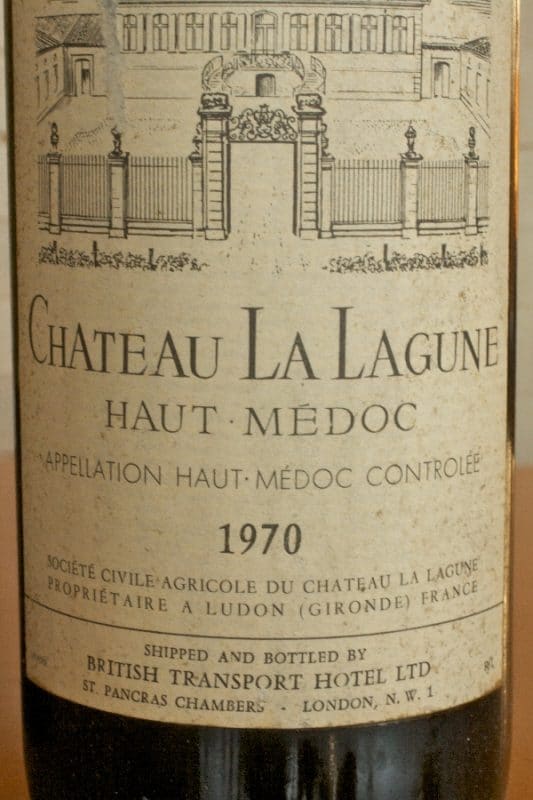
Top wine of the evening, with 5 out of 15 tasters voting for it, was second growth Ch. Ducru Beaucaillou 1970.  The Ducru led with classic cedar box and perfumed bouquet and still had beautiful sweet fruit and a mildly tannic finish.  Not many of these wines showed that balance, and where they were grippy it was in a drying out way, not still lively tannins. Interestingly, Michael Broadbent many years ago stated that aside from Latour and Cheval Blanc, this was the best bottling of the 1970 vintage.  From the same vintage but rather less prestigious in terms of rankings, Ch. La Lagune also showed really well – a deep colour, most youthful of the bouquets of all these wines, excellent red fruit character.  The other, rather more predictable, star wine was Ch. Palmer 1978, well known third growth with a very imposing label.  We did not taste these wines blind so we will never know how much reputation swayed people’s judgments.   The Palmer was certainly very fine:  capsicum, balsamic and lavender notes on the nose, much more fruit than its 1978 partner and still a fine refreshing finish.  Last up in the top half of the table was another prestigious wine, second growth Ch. Brane Cantenac 1970, which was positively farmyardy and could just about have passed for old Burgundy, with a superb texture, which was a feature of so many of these wines. 

Texture, now there is subject in its own right.  The great thing about fine old wines is the evolution of bouquet and flavour, followed by the mouth feel.  The forceful flavours of young fruit have long gone, the acidity is somewhat attenuated and the tannins have got longer and suppler.  Even some of the less good wines in this line up still showed a remarkable subtlety in the mouth.  Apart from sheer curiosity about longevity, this is a quality which makes it positively worth keeping good or excellent wines for decades to witness how they will develop. 

The ‘we’re still here from the 70s’ wines

Our one wine from the Graves, ie south of the city of Bordeaux, put up a good show in this company: it certainly got the most original tasting note of the evening.  Ch. Malartic-Lagraviere 1978, was a humble Graves then, but has since been promoted to AC Pessac-Léognan.  Notes of green pepper, cattle hair (sic), grass and leather, not much fruit, but that super subtle texture which has been commented on.  Ch. Malescot St Exupery 1976 had some fading plum fruit but was drying out, while that old British favourite Ch. Lynch Bages 1975 still had some cedar and blackcurrant notes and that sinewy, perfectly knit together palate with some freshness.   Our only representative from the right bank (ie from predominantly clay soils rather than gravel) Ch. Trotte Vieille 1975, showed some balsam perfume and old fruit, but was also drying out, from an originally tannic vintage. 

This was a superb evening, further enlivened by some other fine wines, excellent food and great company.  Of the wines, the following should get a mention, however brief:

Champagne, Pol Roger, Brut 2000: a beautiful aperitif but perhaps not quite the wow factor I was hoping for

Ch. Fonréaud, Les Cynes, Bordeaux IMG_1449blanc 2009: prominent oak, then bold lemon fruit and waxy texture (Sauvignon Blanc, Sémillon, Muscadelle)

Ch. de Pez 1982: very fine fruit, tobacco and balsam, very subtle, very good Claret from the ‘Parker vintage’

Clos de Bourg, Première Trie, Moelleux, Vouvray, Domaine Huet, 1990 – a quite superb deep orange gold in colour (see picture on right), only moderately sweet, brilliant marmalade fruit, outstanding

The four colours of 2003 Dom Perignon

IMG_00432003 – the season

Everyone knows that 2003 was an exceptionally hot year in Europe.  Janet and I spent a small part of that summer working in the large garden of friends and found ourselves having to adopt habits more typical of Mediterranean countries – get up early and work outside until late morning, have a long lunch break, and resume the campaign in the early evening.  In the wine world, after the great success of the much more typical 2002 vintage in Champagne and elsewhere in France, the question was could great wine be made in the hot year of 2003?  Nine years on at the launch of the 2003 Dom Pérignon, chef de cave Richard Geoffrey, was, unsurprisingly, upbeat: yes, we did make the 2003, and we always thought we would – it is like 1947, 1959 and 1976 … Unfortunately he did not bring along a bottle of any of these vintages to prove his point!

But it was not just the heat that made 2003 a very demanding year.  The season started with severe spring frosts which led to a loss of viable fruit buds so that in parts of the Côte des Blancs eventual yields were down by up to 75% at 20 hectolitres per hectare.  As a result of this and the summer heat, there was a very small, fast ripening crop.  In line with their usual practice the ripeness of the fruit was carefully monitored in the final weeks of the year. As the thermometer reading soared above 40°, the vines shut down, so no further sugars were made, but the phenolic ripening of the skins and seeds continued.   As the the wine maker told his story he got limited sympathy for having to interrupt his holiday in San Tropez in order to return to the Champagne area for a harvest which started on 25 August, at the time only the second ever August harvest since 1822.  There were many technical challenges for wineries more used to dealing with the harvest of a cool and damp climate – the temperature of the grapes, the choice of when to pick, issues to do with skin contact and then clarification – but they were by no means insurmountable.  It was fine if you were open-minded enough, says Geoffrey with a knowing smile.  The challenge in wine making was to turn strength into intensity.

2003 – the wine

The 2003 wine is remarkable if unusual.  It starts with a fine floral note but this quickly gives way to a range of components – ripe if muted exotic fruit, honey, currently noticeable oak, some herbiness, an intriguing bitterness and a notable minerality.  The palate is currently moderately intense and the acidity, not surprisingly given the heat of the summer, very low by Champagne standards.  If the mark of outstanding wine is its complexity, then this stands out – even if it is right up one end of the spectrum for cool climate wine.  Richard Geoffrey is adamant that there is no basis for the commonplace that wine needs elevated acidity to age well. It is the flavour intensity that matters.  He is sure that the 2003 will age for decades … ending the debate by his assertion that Dom Pérignon 1976 is a now a monument! 

2003 – the colours

So much for the season and the wine, how do Dom Pérignon wish to present the wine?  After the introduction and simple tasting we were treated to an interactive, almost theatrical experience.  In darkened rooms – DP believes in the eternal chicness of black – we are assigned a sommelier and a tasting bar, and led (very willingly) through the colours of white, gold, hibiscus red and blue-black … four colours, four micro dishes with exquisite tasting combinations.  Let’s do the photo blog first:

IMG_0054 IMG_0049

IMG_0057
IMG_0055

IMG_0060

IMG_0059

IMG_0036 IMG_0063

You can’t accuse of Dom Pérignon or their chefs of not trying!  This was a spectacular line-up of colour, the non-colour of black and flavours.  If the idea was to broaden our concept of ‘what goes’ with vintage Champagne, it certainly worked.  For me the most remarkable combination with the wine was the very first – a cream and egg yolk ‘egg’ with cinnamon, a coarse black salt and just a touch of the luxuriant sweetness of maple syrup.  In a ‘like with like’ match, the indulgently rich texture of the dish brought out the richness of the wine, cream meets cream, while in a cross current, the cinnamon brought out the fruit and the whole was livened up with the hit of salt.  This was more than a taste, it was a unfolding series of rich textures punctuated by hits of cinnamon, salt and sweetness.  Remarkable.

The two middle dishes, were very good, but tasting-wine combination were not on the same level.  In the gold dish, the La Mancha saffron was certainly warm and powerful and the Livorno  risotto rice, called Acquarello, holds its marked firmness while being cooked.  The dish was finished off with the intense bite of four year old Parmesan. Despite being a classic combination, I felt the dish stood side by side with the wine.  Similarly with the red number: all the fireworks were from the low salt farmed caviar from Aquitaine on its bed of hibiscus reduction, rather than its interplay with the wine.   However, the textural pyrotechnics returned with the final ‘black’ dish, foie gras and a 40-ingredient mole sauce, including the key contributions of chocolate and mild chilli.  Whatever the colour, richness is the key to 2003 Dom Pérignon. 

Birthday bubbles, streams of Syrah


IMG_1222 One birthday at the Overton blind tasting group, marked by the last of three bottles of a special wine. Lively, bubbles, youngish tasting bright fruit, mild nuttiness, noticeable acidity, balanced and attractive – but not really giving its origins away.  One member in the group in the trade thought it was very, very good Cava – which would make Cava makers very happy indeed: Champagne Dom Pérignon 2000. Very good if slightly underwhelming 
My immediate thought on this was ‘Sauvignon Blanc with attitude’ because of its mildly gooseberry fruit, attractive greenness and high acidity.  From the Mont Damnés, Chavignol, Sancerre, this comes from a micro production: La Fleur de Galifard, Thomas-Labaille, Sancerre 2010: concentrated rather than highly mineral, perhaps because it is made with very ripe grapes.  IMG_1224
Taleia Not many clues on the nose here but then waxy and full on the palate, medium acidity and good length.  Subtle use of oak to give some structure but not flavour.  This is a blend of Sauvignon Blanc and Semillon but not from Bordeaux.  North West Spain was a good punt: more North East: Castell d’Encus,  Taleia, Costers del Segre, 2009, Spain
This is the sort of wine you want in a blind tasting: green apples, lime spritz, petrol notes, low alcohol, off-dry with obvious residual sugar.  German Riesling we all thought rightly (except one experienced member of the wine trade – but that is the joy of blind tasting).  Beautifully balanced and complex: Forsterer Jesuitengarten Riesling Spätlese, Pfalz, 1999 IMG_1229
IMG_1268 IMG_1269
IMG_1231 This was announced as  ‘light red’ which it wasn’t.  The colour was not that deep, but then good dark plum fruit, coffee and some slight stalkiness on the finish.  Once we established we were were in Australia, the question was: ‘Which island of Australia are we in?’ ‘The big one’ was the answer.  A good quality Australian Grenache from the Barossa: Thiele Road, Schwarz Wine Company, Grenache 2006
Chakana Reserve Bonarda Old Vine 2009 from Argentina is not a wine or even style I have come across before. As with Malbec, it is an example of Argentina doing something remarkable with a grape variety which is not seen as a major player in its (in this case) north Italian homeland.  In this wine it presents a bit like Malbec – good dark fruit, chocolate notes, the richness offset by by sharp acidity, very worthwhile.  IMG_1234

IMG_1235
By contrast, here is a great red grape variety doing what only it can do in its homeland – and living up to its big name:  beautiful richness and balance, complex dark sour cherry fruit, liquorice and tobacco notes, herbs, excellent length and precise reflection of where it comes from: I am delighted to say that some spotted that this was indeed Brunello from the Montalcino plateau, one of the great versions of Sangiovese which (only?) Tuscany does: Castiglion del Bosco 2007
The key here was the weight – full of rounded, developed fruit but medium in weight, not a really hot climate wine,  In fact with age, this has developed a sort of elegance not often associated with its appellation.  Some experienced tasters even flirted with the idea it might be Burgundy …  but one person was spot on further south and actually named the producer correctly!  Jaboulet, Crozes Hermitage, 1999 IMG_1238
IMG_1241 This is turning into a stream of Syrah … this one showing good red and black fruit, soft tannins, very drinkable … and, big clue (use all the available evidence!) a very heavy bottle.  From California’s Central Coast: Syrah, Bien Nacido Hillside Estate, Qupé, Santa Maria Valley, 2004.  
And another … a beautiful young Syrah, old world this time … Terres Blanche, AC Saint Joseph, 2007.  The name comes from the steep, low yielding patches of limestone and clay, which produce greater concentration that the domaine’s standard St Joseph.  Very impressive. IMG_1245
IMG_1288 Definitely not Syrah … gorgeous amber brown, a nose of classy old furniture – beeswax – nuttiness, deliberate oxidation and then searing refreshing acidity on the palate. A bit of a debate on Madeira v. Oloroso Sherry, but he who was certain it was the former was absolutely correct:  Justino’s Malmsey, Broadbent Selection, 10 years old: old school and fabulous. 
IMG_1298 IMG_1290

Mission impossible

Asking the owner of an independent wine shop to choose just six wines to show off his wines is definitely mission impossible.  If the shop is a creation of one person, he or she has spent hundreds of hours and selfless tasted probably thousands of wines to pick the stock … and then they have to be whittled down to just six!  But it makes for a good game and the wines should be excellent. And the selection  should tell you a great deal about the owner’s preferences. 

Tim Pearce of Grape Expectations, Andover, was the man on a mission. I had made one stipulation – we must taste his very best Champagne!  And then there were a number of bonus wines too. 

IMG_0984 Pale lemon, fine citrus notes, some melon fruit, sharp acidity and, at least in Tim’s view, some creaminess. We tasted these wines blind – because we like to have a bit of suffering with our pleasure – but this was just too obscure for that game!  This was a north Italian white: Castelfeder, Kerner ‘Lahn’ 2009 which comes from Südtirol or Alto Adige if you prefer, and is made from the Kerner grape, itself a cross between Riesling and Trollinger.  That attractive sharp acidity comes from the 15 degrees of temperature difference between night and day in the area. 
Wine number two was straw in colour, quite aromatic – flowers, sherbet and lemon, with moderately high acidity, medium bodied, persistent with a very dry finish.  ‘Fragrant, cool, good length’ was one comment; and ‘great value at £8’.  This is an excellent bottle from an unlikely source: Catarina 2010, Bacalhôa, Setubal Peninsula, Portugal, 13.5% alcohol but very well balanced.  60% Fernão Pires, 30% Chardonnay, 10% Arinto, with just the Chardonnay being fermented in oak.  IMG_0962
IMG_0987 Now here is a wine to divide opinion!  The fact that we struggled to identify it told its own story.  It isn’t made from an unusual German cross or Portuguese grape varieties … in fact it could not be more more main stream.  After some initially mustiness had lifted (natural wine making), toffee apple and vanilla on the nose with rich apple fruit, good acidity, no signs of oak on the palate: 100% Chardonnay from southern Burgundy, clearly given the big oak treatment:  ‘Aragonite’, Clos des vignes du Maynes, AC Macon-Cruzille, 2009.  Classic Burgundy isn’t, but it is a wine of real character.   
IMG_0963 IMG_0988
Some wines do deserve three pictures.  A superb vintage Champagne, from Henriot, from the good 1998 vintage: still lively mousse, medium pronounced biscuity nose, full bodied rich fruit, wonderful balance combining ageing notes and remaining freshness, great depth of flavour. As one learned commentator wrote: ‘Yum’!  IMG_0964
IMG_0993IMG_0973 Back to the unknown.  Some initial ‘bubblegum’ on the nose led us down the wrong path, then ripe cherries, even cherry icecream.  A north Italian grape variety apparently … we eventually got to Lagrein,  in this wine which I had tasted a few weeks ago.  A red from Castelfeder again: Lagrein 2008. The picture is getting clear: this buyer doesn’t worry about whether the wine is well known or not, he buys what he likes … 
And he likes pairs of wines from the same estate: here is the red from Clos des Vignes du Maynes, AC Macon Cruzille 2010. And is there a twist … you bet there is!  Good raspberry fruit, high acidity, medium tannins, some old oak. So what is the one thing you don’t do with the Gamay grape – oak it of course!  Another super low intervention wine, no added SO2, but then 11 months on the lees in oak barrels.  IMG_0994
IMG_0997 OK, we did spot this one: Pinot Noir in some form or other, raspberry and strawberry fruit, some attractive farmyardy notes, quite structured with lots of fairly linear fruit on the palate, plenty of alcohol, good drinking.  Tim teased me that I had been to this estate … but as I have not ventured out of Europe recently, this seemed unlikely. Clos Henri, Marlborough, New Zealand 2008. But it is indeed from Henri Bourgeois, who I did indeed visit in cool Sancerre just over a year ago.
IMG_0974_2 IMG_0975 - CopyIMG_0976 - Copy
On to the bonus wines.  Here is a wine you definitely can’t buy at Grape Expectations, or probably any where else: Borges & Irmão, Vintage Port 1963.  A case of six made £139  in a Christie’s auction of 2001 … a precious bottle from Tim’s own cellar, a minor house in a great vintage.  Pale, spirity, sweet fruit still with us … IMG_0980_2IMG_0978_2
IMG_0989 Two final bonus wines: a big, bold South African ‘port’ in all but name first: Axe Hill, Mossops, 2002, South Africa.  And then another sweet red wine, but this just 14.5% alcohol, a great Italian classic, Recioto della Valpolicella 2004 from the outstanding Corte Sant’Alda. Clearly some one knows my tastes!  Dense cherry fruit, nice wood notes, super balance of rich red fruit on the palate with mild tannins and a dry finish.  Marinella Camerani’s wines do not disappoint! 

In wine, as in life, it is a good idea to let people with talent express themselves … thanks to Tim and other generous guests for a great evening. 

In the pink

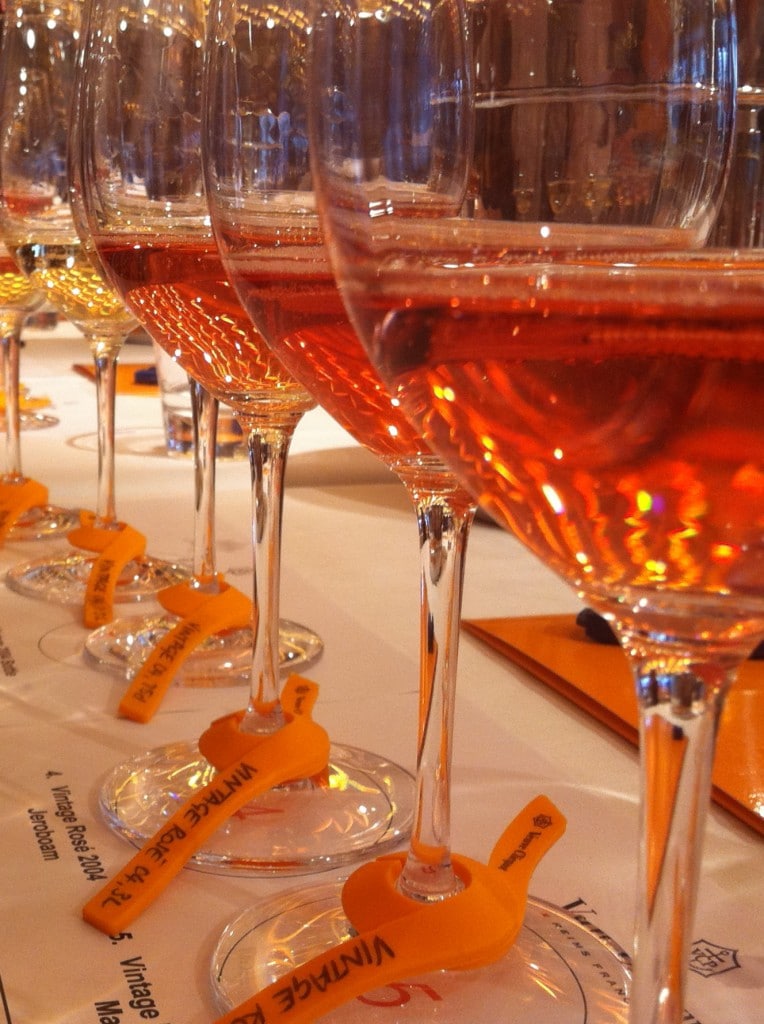
Veuve Clicquot launched their two 2004 vintages wines – white and rosé – with an interesting comparison. What is the effect of bottling these wines in a normal bottle size, a magnum and a jeroboam?
Apart from making a very pretty picture, the answer in a wine of this quality is that there is a marked difference. The smaller the bottle the more you notice the yeast and mushroom aromas of bottle ageing. By contrast, the large bottle preserves the fruit flavours. Either way, these are subtle, highly drinkable and pleasurable wines.

Twins and triplets

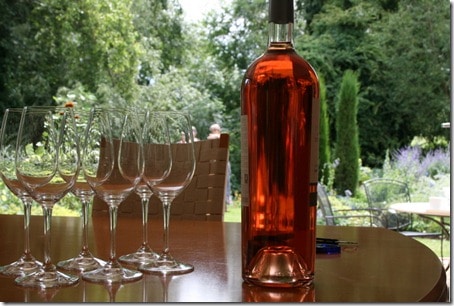
We have been enjoying a number of parties to launch our new garden/tasting room at home.  It replaces a plastic conservatory and is proving a real joy – opening up the entire ground floor of the house, giving lovely views into the garden and creating lots of space.  And of course we have an excuse for a number of wine-themed celebrations.   Here is the splendid magnum of rosé from Domaine Cazes, Roussillon, from the family lunch, a very attractive colour indeed!

IMG_9495You can seat 10-12 in one end of the room for a tasting or meal, and lots more if you go in the other direction.  Here is the ‘before’ scene; the ‘after’ we will leave to your imagination, though there is a picture below.  

IMG_0361

One of the parties was for the tasting group, the BBC (Bring a Bottle Club), which sometimes is a complete free choice for its participating members (BBC 1) or on a theme (BBC 2).  This fell somewhere in between as we wanted to taste some bottles of old Sangiovese.  Others offered to bring a course to eat with matching wines which was a very generous offer. So here goes: 

IMG_0365 Anyone who is kind enough to bring a magnum of vintage Champagne is excused any other IMG_0368contribution!  Champagne Vilmart, Grand Cellier D’or 2000, Premier Cru – pale to mid gold, rich on the nose (70% Chardonnay, the rest Pinot Noir), nutty, refined yeastiness, pronounced palate, subtle and substantial at the same time. 
Domaine Cheveau’s wines have made quite an impression at Caviste and this Pouilly-Fuissé 2009 Les Trois Terroirs was no exception.  Full of lively apricot fruit, most plumped for white Burgundy, with a small (and wrong) faction for Viognier. I was in the latter group but a warm year in southerly Burgundy was a fair meeting point.   

IMG_0371

IMG_0370

Twins from  Ridge California Chardonnay accompanied a delicious smoked salmon parcel dish which I failed to photograph but certainly enjoyed eating.  We all agreed on Chardonnay; some thought one from the new world and one from the old, but in fact Santa Cruz Mountains is made with grapes from the young vines, while Monte Bello is the older sibling.  In both new oak is still quite prominent (2007), fruit sweetness and varying levels of toffee and golden syrup notes …
Triplets from Tuscany followed, with my version of Wild Boar and Olives … People may have rememberedk the Sangiovese hint, but the view was that the 2007 and the 2003 were related wines and that 1999 was ‘different’. In fact this was three vintages of Castello del Trebbio, Lastricato, Chianti Rufina riserva – with the oldest wines outshining the youngsters.  A fuller comment on this mini-vertical can be found here.   IMG_0375
IMG_0373 Warning: we are entering unusual wine territory!  A bonus bottle from a tiny production Spanish producer which we couldn’t easily place.  Delicious, full of character, ripe fruit, lots of substance … Spanish … we still had no idea. In fact Rioja but made solely with Graciano and Garnacha, and no hint of Tempranillo. Tiera Fidel, Rioja 2007.  Interesting but quite expensive (£30).  
Even further off the beaten track:  very rich, red-berried fruit, ripeness, some sweetness, dense and … it turns out to be a wine made from three passes through the vineyard for Groppello and Marzemino grapes, the grapes allowed to dry out for three weeks (semi-passito), then six months in barriques:  there are less than 1,000 bottles of Simut from Leali di Monteacuto, 2004 on the western side of Lake Garda, Italy.   IMG_0419

IMG_0398

There is nothing particularly obscure about vintage port but nobody guessed the identity of this sweet red wine … 10th wine of the evening?  thrown off balance by rare Italians? A trial first bottle of a case: sweet, red, young, with high acidity and many, many years ahead of it.  Quinta do Crasto 2003 takes its first bow and accompanied a magnificent cheese board. 
IMG_0396
We entered the last lap: a quintet of sweet(ish) whites, including a trio of wines made from Chenin Blanc, of which in turn two were twins from one producer – though of course no one knew about this whole set of relationships at the time. IMG_0385
IMG_0403 The first of the five was off-dry to the slight surprise of the person who brought it.  A pale amber in colour, floral, old apples and cheese on the nose, mild woody notes, yeast – a complex and typically interesting wine from Huet: Le Haut-Lieu, Vouvray 1989.  Chenin Blanc of this quality and initial level of acidity can age for decades.  For further vintages, click here

Château Doisy-Vétrines, Grand Cru, Sauternes, 1996, a beautiful, structured and elegant wine, sweet with honey notes, biscuit and marmalade flavours from the effect of botrytis, toffee apples, good refreshing finish.  Guesses of the vintage neatly spanned the actual date. 

sauternes
IMG_0410 A final trio of wines, which in fact were French twins and an Italian non-relative.  Some of us did detect Loire Chenin Blanc in the twins, this time in a sweet style.  The first was lighter, moderately sweet, rich in fruit, good acidity.  In the mouth it was luscious and with a hint of marmalade richness.  The second was massively sweet, richer, massively marmaladely…perhaps a bit ‘obvious’.
They turned out to be a pair from Domaine de Montgilet (Victor e Vincent Breton) and the appellation is Coteaux de L’Aubance in Anjou.  The first was the more expensive  Clos des Huttieres 1999, while the second, which people preferred as it was more expressive, was Les Trois Schistes, 2002 IMG_0431
IMG_0426 Finally, people really loved the Italian non-relative, burnt sugar and toffee apples wine, with its marked toffee, old wood and oxidative notes.  The best guess was for Madeira, but in fact it was a Tuscan Vin Santo from a domestic sized production by Lucia D’Antillio Bacci: Fattoria Santa Maria, Montescudaio, 2000 is excellent: rich, sweet and nutty and an amazing bargain at €12.50. You can see pictures of the estate here.

Thank you to members of the BBC for launching our garden/tasting room in such style – may your choices of wine be ever more rewarding/adventurous (delete as required!) 

Sign me up!
Pages