Posts Tagged ‘Jaboulet’

Art of fine living at the Harrow

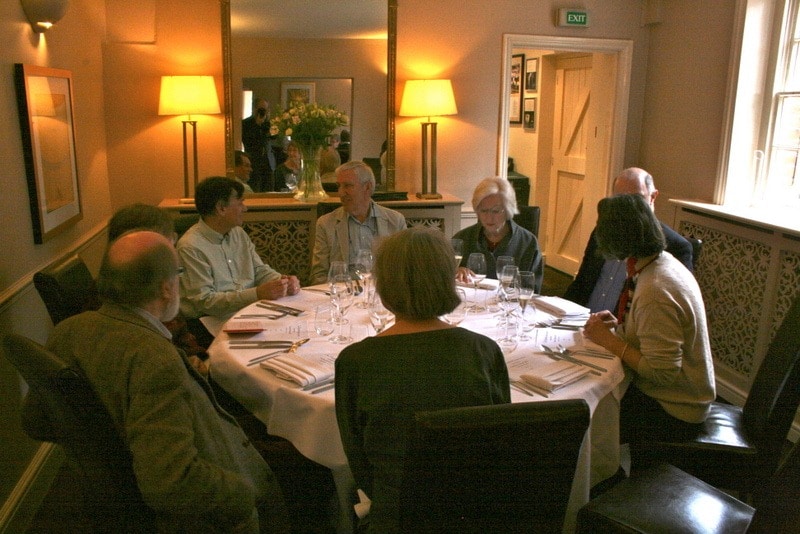
IMG_1459February’s meeting of Andover Wine Friends was a spectacular lunch at The Harrow Inn, Little Bedwyn.  They put on a great show for 17 of us, while running the front half of the restaurant as usual.  I was seriously off duty – too much good food, company and excellent wines – so there are no detailed notes this month.  However, here are a selection of photos of some of the seven or so courses plus cheese, almost entirely from these islands. And a brief note on some outstanding wines.

The approach in this restaurant is easy to describe – genuinely warm hospitality, outstanding sourcing of ingredients, perfect timing in the kitchen, innovative combinations and a profound love of wine.  What a great combination!  The event started well with Ruinart Blanc de Blanc Champagne, being poured above left. 

IMG_1462

IMG_1467IMG_1473


IMG_1475

IMG_1476

And the wines? Some were bought at the Harrow and some came from people’s own collections. To pick out some unfairly:

  • the Ruinart is wonderfully balanced and very refined
  • Didier Dagueneau Pouilly-Fumé Silex, Loire – great, concentrated mineral Sauvignon Blanc … because there is a tradition of drinking this great wine at the Harrow
  • a stunningly good, moderately priced Semillon from Australia which the Harrow stocks: Mount Horrocks Semillon, Clare Valley, Australia
  • a wonderful white Grenache (not a phrase you can often employ!) from Catalan Spain – Ctonia, Masia Serra
  • three Rieslings to compare – Eden Valley, Australia; classic Mosel; Schlumberger Grand Cru from Alsace
  • decent Condrieu from Christophe Pichon and Cornas from Domaine de Rochepertuis
  • sadly another ‘drink at the Harrow’ tradition here did not come to pass as the 1985 Hermitage from Jaboulet was over the hill – I suppose in this case it just rolled gracefully down the hill
  • Spinnifex’s Indigene and Shiraz-Mataro from the Barossa, big fruit numbers but beautifully structured and complex, especially the latter
  • there were quite a few others which probably deserved a mention …
  • and finally, a brilliantly concentrated and only moderately sweet Banyuls: Coume del Mas Quintessence Banyulus Rouge
  • some people found a little space to try two different Grappas

With many thanks to the whole crew at the Harrow – you deserve your success.

Birthday bubbles, streams of Syrah


IMG_1222 One birthday at the Overton blind tasting group, marked by the last of three bottles of a special wine. Lively, bubbles, youngish tasting bright fruit, mild nuttiness, noticeable acidity, balanced and attractive – but not really giving its origins away.  One member in the group in the trade thought it was very, very good Cava – which would make Cava makers very happy indeed: Champagne Dom Pérignon 2000. Very good if slightly underwhelming 
My immediate thought on this was ‘Sauvignon Blanc with attitude’ because of its mildly gooseberry fruit, attractive greenness and high acidity.  From the Mont Damnés, Chavignol, Sancerre, this comes from a micro production: La Fleur de Galifard, Thomas-Labaille, Sancerre 2010: concentrated rather than highly mineral, perhaps because it is made with very ripe grapes.  IMG_1224
Taleia Not many clues on the nose here but then waxy and full on the palate, medium acidity and good length.  Subtle use of oak to give some structure but not flavour.  This is a blend of Sauvignon Blanc and Semillon but not from Bordeaux.  North West Spain was a good punt: more North East: Castell d’Encus,  Taleia, Costers del Segre, 2009, Spain
This is the sort of wine you want in a blind tasting: green apples, lime spritz, petrol notes, low alcohol, off-dry with obvious residual sugar.  German Riesling we all thought rightly (except one experienced member of the wine trade – but that is the joy of blind tasting).  Beautifully balanced and complex: Forsterer Jesuitengarten Riesling Spätlese, Pfalz, 1999 IMG_1229
IMG_1268 IMG_1269
IMG_1231 This was announced as  ‘light red’ which it wasn’t.  The colour was not that deep, but then good dark plum fruit, coffee and some slight stalkiness on the finish.  Once we established we were were in Australia, the question was: ‘Which island of Australia are we in?’ ‘The big one’ was the answer.  A good quality Australian Grenache from the Barossa: Thiele Road, Schwarz Wine Company, Grenache 2006
Chakana Reserve Bonarda Old Vine 2009 from Argentina is not a wine or even style I have come across before. As with Malbec, it is an example of Argentina doing something remarkable with a grape variety which is not seen as a major player in its (in this case) north Italian homeland.  In this wine it presents a bit like Malbec – good dark fruit, chocolate notes, the richness offset by by sharp acidity, very worthwhile.  IMG_1234

IMG_1235
By contrast, here is a great red grape variety doing what only it can do in its homeland – and living up to its big name:  beautiful richness and balance, complex dark sour cherry fruit, liquorice and tobacco notes, herbs, excellent length and precise reflection of where it comes from: I am delighted to say that some spotted that this was indeed Brunello from the Montalcino plateau, one of the great versions of Sangiovese which (only?) Tuscany does: Castiglion del Bosco 2007
The key here was the weight – full of rounded, developed fruit but medium in weight, not a really hot climate wine,  In fact with age, this has developed a sort of elegance not often associated with its appellation.  Some experienced tasters even flirted with the idea it might be Burgundy …  but one person was spot on further south and actually named the producer correctly!  Jaboulet, Crozes Hermitage, 1999 IMG_1238
IMG_1241 This is turning into a stream of Syrah … this one showing good red and black fruit, soft tannins, very drinkable … and, big clue (use all the available evidence!) a very heavy bottle.  From California’s Central Coast: Syrah, Bien Nacido Hillside Estate, Qupé, Santa Maria Valley, 2004.  
And another … a beautiful young Syrah, old world this time … Terres Blanche, AC Saint Joseph, 2007.  The name comes from the steep, low yielding patches of limestone and clay, which produce greater concentration that the domaine’s standard St Joseph.  Very impressive. IMG_1245
IMG_1288 Definitely not Syrah … gorgeous amber brown, a nose of classy old furniture – beeswax – nuttiness, deliberate oxidation and then searing refreshing acidity on the palate. A bit of a debate on Madeira v. Oloroso Sherry, but he who was certain it was the former was absolutely correct:  Justino’s Malmsey, Broadbent Selection, 10 years old: old school and fabulous. 
IMG_1298 IMG_1290
Sign me up!
Pages