Posts Tagged ‘Marlborough’
Rhône varieties – home and away
Following last month’s highly successful tasting on Bordeaux grape varieties around the world, this month’s fine wine supper focused on the Rhône varieties. In fact this turned out to be too big a subject matter, but we had such great wines from the northern Rhône that it became a matter of ‘home and away’. The other big difference is that Rhône varieties are all stars grapes in their home territories. Unlike Bordeaux there are no varieties which are minor at home and have become stars in another place. Syrah and Viognier strut their stuff at home, Marsanne and Roussanne do well too and the key grapes of the south are originally from Spain anyway and have hit the world stage from an adopted home: Grenache and Mourvèdre, originally Garnacha and Montastrell/Mataro. Cinsaut and the minor whites are not really stars anywhere unless you think of the former’s role in the best rosés of Provence and, anyway, according to Jancis & co, it is likely to be from Languedoc anyway. So perhaps ‘home and away’ is the correct theme. On to the wines!
The aperitif for the evening was provided by the southern Rhône. The south of France is famous for its rosés, whether elegantly pale or full bodied and structured. ‘La Dame Rousse’, Domaine de la Mordorée,Tavel AC, 2010, 14.5% is certainly in the latter camp with 14.5% alcohol by volume: cherry, boiled sweets and marzipan on the nose, still very fresh with a fine, substantial palate of red fruits, medium to high acidity and weight in the mouth. Would go brilliant with food too.
Our first ‘home and away’ pair featured the now well travelled Viognier, famously rescued from near extinction by Georges Vernay (see the penultimate red wine below) in the then tiny
appellation of Condrieu after the second world war. Our pair showed how differently it can turn out. Domaine Christophe Pichon, Condrieu AC, 2009 is really trying to be a big white Burgundy with its restrained, structured elegance and weight in the mouth, with buttery and candied fruit flavours. Half the wine does time (nine months) being matured in barrels which are only 10% new but the effect is to tone down Viognier’s attractive fruitiness. Meanwhile the outstanding fruit from a very unusual and tiny plot of Viognier in Marlborough, New Zealand is 50% fermented in oak. Viognier, Churton, Marlborough, New Zealand, 2010, 14.8% does the obvious really excellently: powerful aromatics of new oak and luscious fruit with the quintessentially Viognier apricot and peach to the fore. It was similar on the palate with the fruit heading in an even more exotic pineapple direction. Most people much preferred the Marlborough offering.
The second ‘home and away’ pair focused on what has come to be known as GSM, Grenache, Syrah and Mourvèdre. This trio are the work horses of the massive Côtes-du-Rhône appellation, France’s biggest wine export to the UK. The wines
can be anything from mundane to marvellous and this is a very good example from Lirac which has an appellation of its own. The mix for Château d’Acqeria, Lirac AC, 2009, 14% is 50% Grenache and 25% each Syrah and Mourvèdre and it was a bundle of berry fruit, spice and vanilla with a structure held together with fine tannins. The style is a bit too modern (new oak) for me but there is no denying the quality and poise. By contrast our ‘away’ wine was Red (that’s original!), Eben Sadie, Sequillo, WO Swartland, South Africa, 2009, 14.5%. This was a big, powerful, number with those berries again but this time balsam and cedar wood, a fruit-ripe sweetness on the palate, long and outstanding. It was very young indeed but shows great promise. From an unspecified blend of Syrah, Mourvèdre, Grenache accompanied by the southern French duo of Carignan and Cinsault.
Three Syrahs marked the climax of the evening, two from the northern Rhône’s top two appellations and one from the Barossa Valley which has developed a world-beating style of its own. The hill of Hermitage, rising above the left bank of the great southern river, produces what was the greatest French red wine in the world in the eighteenth century, long before Bordeaux was classified. It produces dark, intense Syrah which can age for decades. Our example was very young but impressive:
Les Miaux, Ferraton Père et fils, Hermitage AC, 2007, 14%. Farmed biodynamically, this spends no less than four weeks macerating on the skins to extract all that colour and the tannins for the long haul. It was already showing red berry, pepper, smoke and meat notes with great concentration and length … and it has barely begun to develop. The second Rhône example had some of that bottle age: Maison Rouge, Côte Rôtie AC, Domaine Georges Vernay (of Condrieu fame), 1997, 12.5%. There was a marked contrast here between the fully mature nose of balsam, cedar, mushroom and red fruit and the remarkably young, super sweet fruit palate with its long, supple tannins. And it was not a big alcoholic number – note that 12.5% alcohol.
The final wine of the evening was big – but big, complex and satisfying. Powerful dried figs and caramel to start with, then black fresh and dried fruit, excellent acidity to shore it all up, mouth filling and balanced. Basket Press Shiraz, Rockford, Barossa Valley, South Australia 2003, 15% is a tribute to the monumental Shiraz of dry farmed Barossa – but had all the complexity and depth of a great wine just getting into its stride after a decade or so. The producer tells you nothing about how it is made but that the fruit comes from very old vines – between 60 years and staggering 136 years. It is one of the ironies of the so-called new world that most of the oldest vines still in production are to be found there.
This was a great evening marked by the outstanding quality of the wines. We may not have had time for the Marsanne/Roussanne duo or the minor southern blending varieties but there was no shortage of quality, nor contrasts in styles – whether the Rhône grape varieties were home or away.
Staete Landt–European style in NZ?
Saturday’s fine wine supper featured Staete Landt, the high quality Marlborough, New Zealand, estate, run by Dutch couple, Ruud Maasdam and Dorien Vermaas. The name is the one given to this land by the Dutch explorer Tasman in 1642 – though apparently he did not actually land on it and it was Dutch geographers who gave the two islands the name it currently enjoys, which was later Anglicised by the British. Stylistically, the wines of Staete Landt (pronounced State Land) also owe something to Europe too. On the whole New Zealand’s wines, whether at good or very good quality levels are marked by bright fruit and the attempt to preserve this at all costs in the wine making. This is after all the land that brought up aggressively green Sauvignon Blanc and red fruit character in Pinot Noir that some Burgundian growers would love to have. Staete Landt’s wines do not lack fruit but there is more to them than that. They aim for complex aromas and flavours which marry fruit and wood influence, especially old wood with its modest oxidative effects on wine. And, surprisingly – and on this occasion to our cost – the company seems to prefer corks to screwcaps. Two out of ten bottles in this tasting were faulty – the Pinot Noir was corked (a great shame as this is an important wine for them) and the older Pinot Gris was showing more like an over-the-hill ten year old than a four year old.
But the remaining wines showed the quality on display here. Of the whites the Pinot Gris and the Chardonnay really sang. The Pinot Gris 2010 had the characteristic contrast between an attractive but restrained nose and a rich palate of stone fruit with a nutty texture that would only develop with age. It is partly fermented and then aged in neutral oak. Sadly the 2008 was mid-gold in colour, with marked toffee notes and a flat finish – no sign of the lovely fruit which it will have had. Both vintages of Chardonnay were text book however, 2008 and 2009. Long slow fermentation in French oak, 20% of it new, holding the wine on fine lees and then 18 months maturing in barrels picks up the European theme. But the result is very impressive – a subtle combination of yeasty, oak effects complement the lemon through lime and ripe apple fruit, complex on the nose and pronounced on the palate. Superb.
Riesling Dry 2009 and ‘Annabel’ Sauvignon Blanc 2010 (the latter got the screw cap prize) were good without being quite in the same class. The Riesling was true to type – developing kerosene notes over green apple and with time, stone fruit, flavours, more than medium bodied and fine zippy acidity. The Sauvignon was quite reined in, with 20% fermented in 6-10 year old barrels: classic green notes, some peachiness and tropical fruit, minerality, high acidity of course, just a bit linear as this variety tends to be. Riesling Auslese 2009 is pleasant enough with its best feature being the way the moderate sweetness (30 grams per litre of residual sugar) marries with the acidity and green apple and lime fruit on the second half of the palate. We weren’t sure there was enough there to merit long ageing. The Viognier 2010 split opinion – some loved its warm, honeyed peach fruit and citrus zest, others found the fatness a bit much and were aware that it would only get fatter as it aged. But very worthwhile nonetheless.
And the reds? We have already mourned the demise of the Pinot, so that just left us with the Syrah 2009 which in cool Marlborough is an interesting challenge. As with the whites, they really work hard at this with a cold soak for 7 days and then a long 30-40 day post-fermentation maceration on the skins. This is pushing it and even merits an exclamation mark after the ‘30-40’ days on the website! The wine is aged for 20 months in French barriques, 40% of which are new. After all this effort, the result is a nose of intense and elegant red fruit with a soft palate with excellent fruit-acidity balance. Surprisingly little tannic structure raised a question about its longer term development. The positives here are obvious, but some will not warm to this very soft style.
All-in-all this European style of New Zealand wine making is much to be commended – though screwcaps (or better corks) would be a welcome New World feature. The Staete Landt wines are certainly classy.
At last some wines we recognise!
Guest post: Rob
As regular readers of this blog know, the BBC has seen a recent trend of the rise of the “joker”, as some members of the group have sought to test our blind tasting skills by the ever more unusual offering. Did last Tuesday 21st August meeting see the start of the fight back by others offering the blindingly obvious (pun intended!). Well, perhaps.
With thanks to Rob, not only for the guest post, but for the amazing 1955 Banyuls Grand Cru.
Blind tasting improbability index
As stated many times on this blog, exposing yourself to trial by blind tasting is a mug’s game. My worst moment was failing to identify the grape variety of an Alsace Grand Cru Gewurztraminer. After I knew what it was its typical rose water and lychees aromas were as obvious as it gets. And yes there are a few easy hits – Riesling, young or aged, tends to announce itself, classic Pinot Noir should not be too difficult – but generally it is extremely challenging. The brain plays funny tricks on you; smells and tastes are difficult to pin down; increasingly, New World producers are successfully imitating the ‘European’ restraint, while the climate warms up in Europe producing ripe fruit which could come from warmer locations. So what the world needs is a blind tasting improbability index, the BTII to the cognoscenti: 0 for wines so bland that they could be made from a blend of the European wine lake or grape varieties so obscure that even the grape grower doesn’t really know what they are called, 7 for classic Bordeaux blend in a cool climate, 9 for young New Zealand Sauvignon Blanc and so on.
On ‘the index’ (as I as sure it will be known), wines at the late April Bring a Bottle Club scored pretty low: one grape variety which nobody had heard of before, one rare blend, a red wine from a famous white wine maker, and a white wine from an appellation almost uniformly associated with red. And I thought there was supposed to be only one joker per evening! Ok – there were also two Clarets, one showing classic characteristics, the other rather atypical. Let’s give the index its first outing.
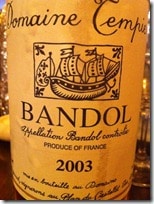
| Curiously amber in colour, this had some oxidised notes as well as toffee and floral aromas. On the palate is was a bit waxy (?Marsanne) with a rather drying finish. It turned out to be Domaine Tempier, AC Bandol Blanc 2003 – probably suffering from the heat of that year. Mostly Clairette with Bourboulenc, Ugni blanc and 3% Marsanne! But an unusual white from a famous red AC: BTI index 2 or 3 at most, though well done to those who thought it was a Rhone white which was in the right area. | |
| By contrast this wine had a BTI score of 7 or 8. Restrained green herbaceous and grassy notes, some very mild pleasant oak on the palate, more assertive ripe fruit towards the finish. TerraVin, Marlborough Te Ahu 2008 is a very good oak-fermented Sauvignon Blanc. My only real success of the evening as I spotted correctly the grape variety, the oak and the New World origin despite the restraint. | |
| Medium deep ruby in colour, quite aromatic on the nose, a rather thin palate of plum, cherry and perhaps a hint of chocolate. I joked that from the colour it could not be Pinot Noir; in fact it was a blend of oak aged Pinot and Rondo – which I later learnt has some non-vinifera genetic material in it which gives it good protection from winter frost and downy mildew. Useful in northerly climates: Wickham Reserve 2008, a local vineyard here in north Hampshire. Joker no. 1 and BTI index of 2 or perhaps 3 for a wine that is local. | |
| Joker no. 2 and BTI index of –2 (ah, you mean you didn’t know the index has negative numbers?). Which red wine has some bell-pepper and cedar notes but then high acidity and tannins, a rasping palate of some interest but not very polite manners? A clue (of sorts): it is a relative of a grape variety which makes a famous white wine. Step forward (and then backward quickly) Listán Nero, the red version of the Palomino variety, the main stay of Sherry. Tajinaste, Valle de la Orotava, Tenerife, 2010. | |
| By contrast, this wine should have been both a great treat and a relatively easy spot, BTI index 8. Moderately rich fruit, leafiness and a rather farmyardy note on the nose, with fair fruit but very high acidity and marked tannins on the palate. An old Bordeaux favourite, but in this particular example the balance of wine was not quite right for chateau or vintage: Ch. Batailley, AC Pauillac Grand Cru Classé (fifth growth), 2002 | |
| Same BTI score or a nudge up as this wine did exactly what it was expected to do. On the ruby/garnet border in colour with a broad rim, well integrated oak effects, restrained red and black fruit, medium acidity and tannins which were a bit chalky: still in Bordeaux but rather humbler if absolutely true to type: Ch. Cissac, Cru Bourgeois, Haut-Médoc, 2000. Enjoyed by all, wide consensus as to its identity. | |
|
|
Classy and elegant nose, oak, red and black fruit which managed to be both sumptuous and restrained, The fruit is bright and very attractive – but doesn’t fall entirely into one obvious varietal or wine style, but there is no doubting the outstanding quality. I guessed right but was not really sure as the intensity and structure of the fruit threw put a question mark against Tempranillo: R. López de Heredia Tondonia, Vina Cubilla, 2005. Marketed as a Crianza but much better than that would suggest. 65% Tempranillo, 25% Garnacha, with some Mazuelo and Graciano. Wine of the evening, BTI index 7.5. |
| A bonus bottle with the cheese which followed the Red Lion’s superb lamb dish. Pronounced wood notes, rich, caramel, something spicy, obviously fortified, rather too chunky on the palate for my liking: Marks and Spencer’s Dry Oloroso Sherry, made by the excellent Lustau. BTI index 8.5. Score could be higher but, sadly, we just don’t drink much quality Sherry. |
Average BTI score over eight bottles? a miserly 5. This shows how difficult an evening it was – but note that the average conceals a lot of very low scores and some high ones. The BTI – like our tasting skills – might need some honing.
Mission impossible
Asking the owner of an independent wine shop to choose just six wines to show off his wines is definitely mission impossible. If the shop is a creation of one person, he or she has spent hundreds of hours and selfless tasted probably thousands of wines to pick the stock … and then they have to be whittled down to just six! But it makes for a good game and the wines should be excellent. And the selection should tell you a great deal about the owner’s preferences.
Tim Pearce of Grape Expectations, Andover, was the man on a mission. I had made one stipulation – we must taste his very best Champagne! And then there were a number of bonus wines too.
| Pale lemon, fine citrus notes, some melon fruit, sharp acidity and, at least in Tim’s view, some creaminess. We tasted these wines blind – because we like to have a bit of suffering with our pleasure – but this was just too obscure for that game! This was a north Italian white: Castelfeder, Kerner ‘Lahn’ 2009 which comes from Südtirol or Alto Adige if you prefer, and is made from the Kerner grape, itself a cross between Riesling and Trollinger. That attractive sharp acidity comes from the 15 degrees of temperature difference between night and day in the area. | |
| Wine number two was straw in colour, quite aromatic – flowers, sherbet and lemon, with moderately high acidity, medium bodied, persistent with a very dry finish. ‘Fragrant, cool, good length’ was one comment; and ‘great value at £8’. This is an excellent bottle from an unlikely source: Catarina 2010, Bacalhôa, Setubal Peninsula, Portugal, 13.5% alcohol but very well balanced. 60% Fernão Pires, 30% Chardonnay, 10% Arinto, with just the Chardonnay being fermented in oak. | |
| Now here is a wine to divide opinion! The fact that we struggled to identify it told its own story. It isn’t made from an unusual German cross or Portuguese grape varieties … in fact it could not be more more main stream. After some initially mustiness had lifted (natural wine making), toffee apple and vanilla on the nose with rich apple fruit, good acidity, no signs of oak on the palate: 100% Chardonnay from southern Burgundy, clearly given the big oak treatment: ‘Aragonite’, Clos des vignes du Maynes, AC Macon-Cruzille, 2009. Classic Burgundy isn’t, but it is a wine of real character. | |
| Some wines do deserve three pictures. A superb vintage Champagne, from Henriot, from the good 1998 vintage: still lively mousse, medium pronounced biscuity nose, full bodied rich fruit, wonderful balance combining ageing notes and remaining freshness, great depth of flavour. As one learned commentator wrote: ‘Yum’! | |
| Back to the unknown. Some initial ‘bubblegum’ on the nose led us down the wrong path, then ripe cherries, even cherry icecream. A north Italian grape variety apparently … we eventually got to Lagrein, in this wine which I had tasted a few weeks ago. A red from Castelfeder again: Lagrein 2008. The picture is getting clear: this buyer doesn’t worry about whether the wine is well known or not, he buys what he likes … | |
| And he likes pairs of wines from the same estate: here is the red from Clos des Vignes du Maynes, AC Macon Cruzille 2010. And is there a twist … you bet there is! Good raspberry fruit, high acidity, medium tannins, some old oak. So what is the one thing you don’t do with the Gamay grape – oak it of course! Another super low intervention wine, no added SO2, but then 11 months on the lees in oak barrels. | |
| OK, we did spot this one: Pinot Noir in some form or other, raspberry and strawberry fruit, some attractive farmyardy notes, quite structured with lots of fairly linear fruit on the palate, plenty of alcohol, good drinking. Tim teased me that I had been to this estate … but as I have not ventured out of Europe recently, this seemed unlikely. Clos Henri, Marlborough, New Zealand 2008. But it is indeed from Henri Bourgeois, who I did indeed visit in cool Sancerre just over a year ago. | |
| On to the bonus wines. Here is a wine you definitely can’t buy at Grape Expectations, or probably any where else: Borges & Irmão, Vintage Port 1963. A case of six made £139 in a Christie’s auction of 2001 … a precious bottle from Tim’s own cellar, a minor house in a great vintage. Pale, spirity, sweet fruit still with us … | |
| Two final bonus wines: a big, bold South African ‘port’ in all but name first: Axe Hill, Mossops, 2002, South Africa. And then another sweet red wine, but this just 14.5% alcohol, a great Italian classic, Recioto della Valpolicella 2004 from the outstanding Corte Sant’Alda. Clearly some one knows my tastes! Dense cherry fruit, nice wood notes, super balance of rich red fruit on the palate with mild tannins and a dry finish. Marinella Camerani’s wines do not disappoint! |
In wine, as in life, it is a good idea to let people with talent express themselves … thanks to Tim and other generous guests for a great evening.
Blind tasting oddities?
Blind tasting of random wines again … I think the best thing is to group the wines by type, clarity after the event being so much easier to achieve than at the time. So off we go with a, er, peculiarity:
Supermarket v. Independent
The relative merits of buying everyday wines from the supermarket or from an independent wine merchant in the UK are worth rehearsing. As I see it, they are:
Supermarket
|
Strengths |
Weaknesses |
| Huge buying power | Little or no knowledgeable service at point of sale |
| Can offer good good value | but obsessed by 2-for-1 offers, many of which only offer average value for money: cheap wine at a low price. This has distorted more positive notions of value for money in the whole UK market – but that’s a subject in its own right. |
| Continuity of lines – if you like it you can go back for more | For the the shelf-space, increasingly narrow offer |
| Quality and value-for-money to be found in their premium own brand ranges, eg Sainsbury’s Taste the Difference | Most of the wines are sound but dull |
Independent
|
Strengths |
Weaknesses |
| Good to excellent selection of wines reflecting buyer’s knowledge and interests | Can be seen as (or indeed can be) intimidating. Despite all the improvements over the years, wine merchants are still seen as places where your ignorance may be exposed! |
| Can buy wines in small quantities from small growers and niche markets | The presence of expensive wines can give the impression that they don’t have everyday ones at reasonable prices |
| Knowledgeable service | Doesn’t stock everything else you need for the week’s shopping! |
| Must be consumer oriented in order to survive/succeed | |
| Can get to know individual customers and their preferences |
Andover Wine Friends’ summer party put this comparison to the test with a blind tasting of pairs of similar wines from Asda’s ‘Extra Special’ range and Andover’s very own Grape Expectations. Billed as Philippa v. Tim (ie Philippa Carr MW, Asda’s chief wine buyer, v. Tim Pearce of Grape Expectations) the tasting showed interesting issues about price and that most people can spot the difference between supermarket and independent’s wines. Of the six pairs a majority called it right on four out of six times, with one dead heat (for a very good reason!) The underlying assumption was voiced by one member: ‘I assumed that the better wine was from the independent and voted accordingly’.
The wines
Cava: Codorníu Teresa non-vintage, £9, v. Mas Miralda 2009 Asda Extra Special £10 – people voted correctly for the more aged, yeasty style of the Codorníu over the refined fruit palate of the latter.
Viognier: Aristocrate 2009, £6.50 v. J C Mas 2010 Asda Extra Special £7 – people overwhelmingly preferred the subtle palate of the former, though they like both wines, and the independent’s wines was cheaper too!
Riesling: Foxes Island, 2008, Marlborough, New Zealand, £12.50 v. Clare Valley 2008, Asda Extra Special £8.70. People got this right by a two to one majority – but they also noted the substantial extra cost of the independent’s wine.
Rosé: Trasquanello Rosato Toscano 2010 £10 v. Portuguese Rose Wine, Bebidas Portugal, non vintage, £3.28. A bit of a curve ball! Asda doesn’t appear to have a rosé in their Extra Special range so I chose the latter of these two as it had won a silver medal in a big competition, while the unusual Sangiovese rosé is trading on its name, ie its relation to Chianti. A large majority guessed right – the inexpensive rosé had a slight fizz and came in a traditional squat bottle. But the quality difference was not that great – and one was three times the price of the other!
Barbera d’Asti: ‘Ceppi Storici’ (‘historic stems [of vines']’), Araldica 2007, Piemonte, £7.45 v. Asda Extra Special, 2009, £5. The second curve ball of the evening. Both these wines are made by the very good Araldica cooperative and admirably there was a tie in the vote for independent v. supermarket. The vintage difference was not that marked. So they both showed attractive brambly fruit, some mild smoky oak notes, decent acidity, good colour, easily drinkable because of the low tannins, but one was £2 less than the other.
Pinot Noir: Chilensis Reserva 2009, Maule, Chile £6.95 v. Marlborough, New Zealand, Asda Extra Special 2008, £10.18. A big majority got this right, guessing that the second wine was from the supermarket. But everyone was amazed at the price difference and the excellent quality of the £7 Chilean Pinot from Chilensis. Wine in an independent wine merchant can be a great bargain!
This was a very instructive tasting … and lots of fun. It shows, I think, that the quality/price ratio is a not one way street between supermarkets and independents, especially if you keep away from the big, overly promoted, supermarket wines and look out for the ones they have put some personal investment into. Conversely, independent wine shops are not necessarily expensive – though in fairness Grape Expectations really specializes in quality at a reasonable price. And it was a great evening, as the pictures show – including the very fine new wood floor in the extension which we were also celebrating.