Posts Tagged ‘Merlot’

A study in new world ageing

Unfortunately I could not attend the Bring a bottle club this month due, on this occasion, to a work commitment.  But every cloud has a silver lining: here is a guest blog from Rob: 

IMG_1016For the second notable birthday of the month, attention was focussed on a region known by reputation by all of us and especially by our birthday boy. Through the BBC’s association with Caviste we have a fondness for Australian wines, but more so perhaps for the Barossa. Nonetheless we all felt confident of spotting a cooler climate Margaret River chardonnay or cabernet sauvignon: so how would we fair with all of Western Australia to go at?

Two themes emerged. Firstly, in an interesting twist on the excellent Two Ronnies’ “Mastermind” sketch, an ability to identify the next wine and how wines age differently in Western Australia (and classically the whole of the New World) than the old.

First up, four whites of excellent calibre and unanimity of order of preference from the group.

We started with a lively fresh, limey, just-the-right-amount-of-petrol, well, riesling surely? “Chardonnay” declared one member of the group. The 2009 Plantagenet, Great Southern, Riesling was a good example of cooler climate new world riesling.

The second wine was as predicted by our Ronnie Barker, a chardonnay. The Umamu Estate, Margaret River, Chardonnay, was everything we had hoped it would be: creamy, rich, lovely buttery oak well integrated with tropical fruits and, suggested one of us, Greek yoghurt. Everything a well aged Margaret River Chardonnay should be. However, does a 2006 count as “well aged”? The old world would need 10+ years to be as rich; this was lovely at half that age.

The third wine was just as easy to spot: waxy, good palate-weight, lovely balance, tell-tale lanolin. Mid aged semillon surely? “I know what this is!”, one member confidently declared, “McHenry Hohnen’s 3 Amigos”. The Moss Wood Vineyard, Margaret River, Semillon, 2010 was neither a Rhone blend nor mid aged.

Bottle 2Bottle 5The final white was indeed the McHenry Hohnen, Margaret River, 3 Amigos, marsanne, chardonnay and rousanne blend. Creamy, rich, lovely buttery oak, well integrated (I refer to the previous description!): chardonnay surely, but with even more of that richness of which the old world would be proud. 2000 maybe? No, too old; learning how the whites age, a tad younger, 2004? No, 2008!

The four reds offered a different perspective: do Western Australian reds have a closed phase at the same age as the whites are beautifully showing tertiary characteristics?

The first red was unanimously declared as wonderful. “One of the best wines I have had in quite some time”, thought one. Dense, but feminine: burnt pepper and floral notes of a Coti Rotie; silky but rich; pale cherries and roses. The richness and the density of colour showed the Wignalls, Albany, Pinot Noir, to be some distance from an old world cousin, but unlike the whites, from 2007, it was still an energetic teenager.

Bramble jam! Rich, succulent, sweet, brooding, blackberry, damsons, blackcurrant, tell-tale mint and green leaf. Classic Margaret River cabernet sauvignon. One member spotted the blended merlot in the Cape Mentelle, Margaret River, Cabernet Sauvignon-Merlot. We were even not too far away from 2004.

If the 2004 was showing its fruit wonderfully well, the Cullen, Mangan, Margaret River, 2006, a blend of merlot, petit verdot and malbec, was still relatively closed. The nose was not giving much away, although the palate opened up nicely showing violets again (is this a Western Australia theme?) and pepper against a dark, brooding background of dense red fruit. Lovely, but still young.

Bottle 9The final red was even more impenetrable, but then a 2007, Plantagenet, Great Southern, Cabernet Sauvignon would be expected to be more closed than a pinot noir of the same age. Lovely tannins and suggestions of fruit hinted at more to come with time.

A final sweet concluded the evening and returned to the white aging theme. A lovely rich amber colour, suggesting the wine making processes involved, underlined by the rich orange marmalade balanced by lighter apricot. Mid aged, botrytis semillon? Botrytis semillon sure, but the 2009, Vinelane, Noble Botrytis Semillon followed the theme that at three years it showed a depth which a good Sauternes would envy at six years.

South African stars

Writing in the middle of the World Cup in South Africa it is just as well this is about the country’s wine and not about football.  Along with most of the other African teams, the home team could not get out of the group stage of the competition.  Meanwhile England played poorly and departed in the most spectacular fashion.  By contrast, South African wine has much of which it can be proud.

IMG_5429 IMG_5412

The history of wine production in South Africa is long and varied.  Initially famous 300 years ago for the sweet white Constantia, the trade came to be dominated by the production of huge quantities of cheap wine destined for the distillation plant.  But in recent decades a crucial section of the business has been concentrated on quality.  And as this Andover Wine Friends tasting showed, that quality is available in everyday wines as well as in more expensive bottles.  These wines were sourced from a Wine Society offer.

IMG_5403 Klein Constantia Riesling 2008 (£9): the Constantia name lives on, here represented by this good dry Riesling – inviting and lively young varietal nose, good acidity, refreshing, excellent.

Bon Cap Viognier 2009 (£11.50): nice pale gold colour, rather neutral on the nose, not obviously fruity but full of flavour including a slightly salty note on the palate, decent silky texture.

Villiera Chenin Blanc 2009 (£6.75): an inexpensive example of South African’s star white grape variety.  An excellent complex nose, floral and fruity the apples and especially pears register.  An excellent wine at this price level.

IMG_5417 Sequillo White 2008 (60% Chenin Blanc, 20% Grenache Blanc, 10% Viognier, 10% Roussane; £15.50)  This classy white blends Chenin with some white Rhône varieties to produce a mid gold in colour, a fine expressive nose (honey, nuts, a bit of oak), lovely silky texture combined with real structure, fine and long.  Outstanding.

IMG_5406In the Rosé department, we tasted Circumstance Cape Coral Mourvèdre 2009 (£8).  This was many people’s favourite wine – a lovely pale salmon pink, nice perfumed nose, substantial and rounded in the mouth, slightly strawberry fruit, moderate to low acidity.

The reds were somewhat atypical as they were heavily weighted to top quality.  While they were all more than drinkable, the last three would have a lot of development in them.

Douglas Green Shiraz Viognier 2008 (£5) – fully ripe rich fruit (cherries and plums), good balancing refreshment, easy drinking but with real depth of flavour and interest. You can’t really ask more for the price, assuming of course that you like the style.

IMG_5424-1 IMG_5431

Impressive levels of concentration here!

Kanonkop Pinotage 2007 (£17): a big price jump here in a top example of South African’s own grape variety, Pinotage, a cross between Pinot Noir and Cinsault. Deep purply red in colour, complex berry nose, brilliant sweet fruit on the nose and depth of flavour in the mouth, great acidity for keeping and development in the bottle, some good bitter notes. Excellent.

Boekenhoutskloof Chocolate Block 2008 (mainly Syrah with Grenache, Cabernet, Cinsault and Viognier; £18) Brilliant strawberry/raspberry/oak nose, the fruit-oak balance just right on the palate as well, full on and substantial in style, rich texture, excellent.

Meerlust Estate Rubicon 2005 (69% Cabernet Sauvignon, 21% Merlot, 10% Cabernet Franc) Super rich Cabernet nose, very ripe and full of blackcurrant and red fruit, mint, very substantial but balanced.

IMG_5433 IMG_5422-1

Congratulations to South Africa. The football team might need a bit more work, though perhaps not as much as England’s, but the wine already has star quality.

Chianti classico finds its soul

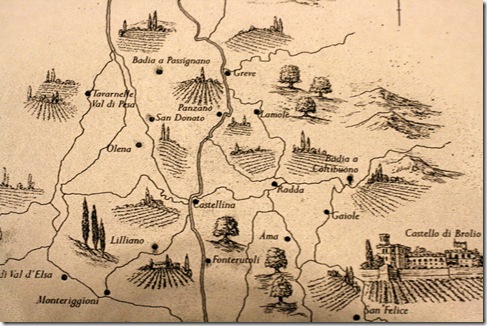
The thirty miles between Florence and Siena takes you through one of the most famous landscapes in the world of wine.  But while the landscape has enduring appeal – gently undulating hills, now smart renovated farms, vineyards, cypresses, woodlands, more vineyards, medieval towns and castles – the wine is little understood.

Line drawing from Hugh Johnson, Tuscany and its wines

This is because the second half of the last century saw this famous name go down all sorts of blind alleys.  It is an undoubtedly an historic wine but one that has only recently begun to settled down with a clear identity. The debate has focused on:

  • the zone:  the classic area was given its first designation by Cosima III de’ Medici back in 1716 but in the 1930s the name of Chianti was bestowed on a vast area of central Tuscany between Pisa and Arezzo and well south of Siena.  It was not until 1996 that the Classico zone was redefined as the historic area between the two historic Tuscan cities.  But how many consumers know the difference between Chianti Classico and Chianti?
  • mass market or quality wine? The 1970s and 80s saw subsidised expansion of  land under vine at the lowest cost and with no regard for quality and the result.  The result was a lot of IMG_5366mediocre wine.  By contrast the Chianti 2000 project undertook research into clones of Sangiovese and has enabled Chianti Classico to head in the quality direction. It was spurred on of course by the fame and fortune that was being made by those creating the Super Tuscans, wines made from French grape varieties especially on the Tuscan coast.
  • the blend: at least since the later nineteenth century this has been Sangiovese plus secondary additions of other grapes to soften the wine.  Up to 20% of the other local grape varieties (usually Canaiolo, Malvasia nera, Colorino) gives you one result; 20% of Merlot, Cabernet or Syrah a completely different one.  So should Classico be a defined Tuscan style or a international red with a Tuscan twist?
  • oak ageing: should the wines be aged in small French barriques, older or newer, or in traditional, larger Slavonian oak barrels?  Or in other words should the fruit have a suave aroma of vanilla and tobacco or the more neutral if perceptible notes of balsamic, cloves and leather?

These questions were given a pretty clear answer in a blind tasting of Chianti Classico wines from the very good 2006 vintage, mostly sourced from the Wine Society.  The selection may of course simply reflect the preferences of their buyers but it showed that Classico does now have a clear identity:

  • pale to mid ruby red
  • distinctive aromas of sour cherry, fresh and dried fruit plus a moderate veneer of oak ageing
  • an absolute maximum of 10% of non-IMG_5388Tuscan grapes.  More than that and the wines may be good but they won’t be Chianti Classico in style, whatever it says on the label
  • good fruit on the palate (but certainly not fruit led) with moderate to high acidity and tannins. The wine at this quality level is  no longer either thin or tough as it was in the past, but it is no pushover either – it is quite rightly a wine of medium intensity, complex, lively and refreshing.
  • an excellent wine to accompany food including fatty/salty food such as prosciutto or tomato based sauces; good persistence.

Chianti Classico seems to have found its proper and distinctive place in a world awash with big, fruit led, wines – and long may it continue in this style.

The wines

IMG_5368

Monteraponi 2006, £14

90% Sangiovese, 10% Canaiolo, 12 months 70% in 23hl casks of Allier oak and 30% second passage barriques.  Pale ruby, medium intensity aromas, nice pretty palate of cherry leading in the raspberry and strawberry direction, lowish acidity, subtle.  Good plus.

Sainsbury’s Taste the Difference Chianti Classico 2006, made by Cecchi from the Villa Cerna estate, £7.50 Sangiovese, Canaiolo and Colorino grapes, but the proportions not declared.  Mid ruby, not a fruity nose but spices, eg cloves, good fruit on the palate which faded in intensity quite quickly but then persisted at a lower level, good plus.  Worthwhile introduction to the style and held its own with wines up to nearly twice the price

IMG_5372

Villa Calcincaia 2006, £11.25

80% Sangiovese, 10% Canaiolo, 10% Merlot, 18 months in Slavonian oak.  Initially muted nose which then opened up, quite perfumed, slightly intenser than average of this field, greater acidity, powerful, quite long if not very complex finish.  The relatively substantial amount of Merlot does not dominate the wine.

IMG_5364Brolio 2006, £13 The website unhelpfully says: Sangiovese with small addition of other grapes, but probably with some French grapes in the mix because of a deeper colour with a continuing purple tinge. Very good fruit but not a clear Sangiovese profile (?Merlot), good persistence.  Very good if heading towards an international style.

Fonterutoli 2006, £16. 90% Sangiovese; 5% Malvasia Nera and Colorino; 5% Merlot.  Purply red, denser colour; rich, clove nose; velvety dense fruit, more obvious tannins, very good if slightly international in style

Villa di Vetrice, Chianti Rufina Riserva 2006, £8.50: 90% Sangiovese, 10% Canaiolo.  Not Classico of course but from the Rufina area directly East of Florence.  The most traditional wine in this tasting. Quite a dense ruby, rich and demanding, Sangiovese very dominant, more tannic than acidic, very good plus if very traditional

An older wine for comparison’s sake, with thanks to David Thomas of Caviste:  Castello dei Rampolla, Chianti Classico riserva 1998, generally viewed as a decent but not outstanding year in Tuscany. No grape variety breakdown available.  Colour very similar to the 2006s, lively pale to mid ruby red, no signs of ageing; complex nose, cloves, some red fruit, leather, fading fruit on the palate but still quite drying tannins.  Drink up.

Favourites

The clear favourite of the tasting group was the Monteraponi with its subtle ripe fruit.  Then came Brolio.  My choice was the traditional wine from Vetrice in Rufina – but that’s just a matter of which style you prefer.

Piemonte 2-3 Toscana: A weekend in Italy part 2

After the Capezzana tasting, the riches of Decanter’s Italian day at the Landmark Hotel.  This has to be the best one-day introduction to the Italian quality wine scene in the UK and maybe beyond.  It’s big – with 86 listed producers – and pretty representative, 13 out of 20 regions present, with Sardinia a surprising absence.  A third of producers are from Tuscany with 16 from Chianti alone, but then we all know about that English love affair.

Faced with these riches, you have to choose.  Janet and I concentrated on filling in a few gaps from our recent Piemonte trip and of course some Tuscan friends.  Here are  some of the highlights.

Damilano, Barolo

This winery, between the communes of Barolo and La Morra, has a great range of wines and of  single vineyard cru.  It is particularly pleased to La Morrabe expanding its holding in the important Cannubi vineyard from two to ten hectares, leasing the additional land from Marchesi di Barolo, which will give them 60% of the cru.  The investment is eye-watering, with one hectare of Cannubi in the €2m range.  And so is the responsibility of moving from 9,000 to 50,000 bottles of this wine per year.

Of the wines we particularly enjoyed Barolo Cannubi 2005, squeezed between two great vintages, now showing better than most expected, with a very rich, complex nose and dense fruit.  But a good word has also to be put in for the Barbera d’Alba 2007 in a modern oaked style (40% new barriques), but a good depth of fruit and quite luxurious.

Michele Chiarlo, Calamandrana, Monferrato

Michele Chiarlo, while being based in the Monferrato region, has important wines from many key areas of Piemonte – whites from the Roero and Gavi, Moscato, an interesting sparkling wine which we drank when we were in Alba, quality Barbera and of course Barolo and Barbaresco.  The highlights included the premium Barbera, La Court, Barbera d’Asti Superiore ‘Nizza’ 2006.  This wine, which from the 2008 vintage has acquired DOCG status, is treated like the top wine that it is – low yields of only 1 kg of grapes per plant, harvested late in the middle of October, half fermented and aged in larger 650 litre barrels, half aged for 12 months in barriques and then for a year in bottles. It shows brilliant dense fruit, complexity and typical great acidity, a powerful but balanced food wine.  The wine received the Gambero Rosso’s top grade of ‘three glasses’ in this excellent vintage, as well as in 2000, 2001 and 2003. It’s great value too at €26 – just over half what you would expect to pay for a Nebbiolo based wine of similar quality.  All the wines we tasted here were very good or excellent: Arneis Le Madri 2009 and Gavi di Gavi Rovereto 2009 were very good, Barbaresco 2006, Barolo Tortoniano 2005 and Barolo Cerequio 2005 were excellent.

So, so far on this football day, an early 2-0 lead to Piemonte.

Marchesi di Frescobaldi

In the Tuscany room, I noticed that Frescobaldi had bought a fine range of wines including top Brunello and Chianti.  But there was also the chance to taste two Super Tuscans, which draw on the cultural and religious symbolism of the Mediterranean, Lucente and Luce.  From these bottles beams the sun rays in embossed golden splendour – can the wines live up to this?  Lucente 2007 – the affordable option – has very good medium weight fruit, good counterbalancing acidity, a decent second level Super Tuscan.  Luce 2006, a 50/50 Sangiovese/Merlot divide, spends two years in barriques and emerges with deep, dense, colour and aroma (prunes and cherries, balsam), great fruit (the Merlot of course to the fore) and lively acidity (Sangiovese makes its mark). Perhaps a wine for tasting rather than drinking, but an excellent achievement nonetheless.

Montenidoli

Having tasted this company’s top Vernaccia di San Gimignano at Vinitaly, I was keen to catch up with at least the other whites in the range from this producer.  Maria Elisabetta Fagiuoli introduced the wines herself and fully justified the company’s slogan Sono Montenidoli – ‘I am Montenidoli’, or rather less likely, ‘They (the wines) are Montenidoli’.   This part of Tuscany is the product a great prehistoric salt-water sea, a land of fossil filled limestone which can produce whites of real character.

The Vernaccia tradizionale 2007 is the product of long maceration on the skins and has very good complexity on the nose though it is rather flatter on the palate. I love this style but if you prefer something cleaner, more fruit led, then there is Vernaccia Fiore 2007, with freshness and even delicacy, some fruit, pleasurable drinking.  Il Templare 2007 is a real marmite wine (Gambero Rosso agrees: these wines don’t leave you indifferent …): 70% Vernaccia, 20% Trebbiano gentile, 10% Malvasia bianca, a distinctly cheesy opening, then herbaceous notes, nice texture, good lemon and melon fruit. We also enjoyed Canaiuolo 2007, the unusual rosé made from Canaiolo,  a Tuscan grape usually relegated to being a blender with Sangiovese. Here it produces a nicely balanced, quite floral wine for summer drinking.

Caiarossa

Dutch investment, French know-how and biodynamic agriculture is the package at this very contemporary venture, near Riparbella close IMG_0159 to the Tuscan coast.  Dominique Génot remembered us from our visit on a tempestuously  rainy day in May 2007 and judging by the wines, since then things have gone from strength to strength.  A fine sweet wine and a dry white have been added to the entry level if excellent Pergolaia (90% Sangiovese) and the top wine, Caiarossa.  The grape mix for the latter sets new standards for a multi-grape wine in Tuscany – you could be in the southern Rhône: around 20% each of Sangiovese, Cabernet Franc and Merlot, plus 12% Cabernet Sauvignon, with small amounts of Alicante, Syrah, Petit Verdot and Mourvèdre.  Or to put it another way, that’s 40% Bordeaux, 30% Rhône and 30% Tuscany.   The show offered three vintages:

Caiarossa 2004: is now beautifully knit together, with a fabulous nose of ripe fruit and savoury wood, rich in texture, complex, satisfying.

Caiarossa 2005: squeezed between two great vintages, this shows more herbaceous notes but still very creditable.

Caiarossa 2006: do not drink this wine yet!  Not that there is anything wrong with it but it is going to be outstanding with its great depths of fruit, zippy acidity, so much potential  – currently very young.

Oro di Caiarossa 2006 and 2007: late harvested Petit Manseng, slow strong pressing of whole bunches, two days of cool maceration, then barrel fermented for  eight months.  A delicious sweet white with apple and nut flavours.  The 2006 shows some oxidation (there are risks in that long slow fermentation), the 2007 is exactly what the maker intended: a sweet wine with freshness, notes of acacia honey, good fruit, very good.

We left the tasting early – me for football reasons, Janet heroically filled in the time shopping.  The cup final, which looked like it could be a mismatch between  the top and bottom teams of the Premier League, exceeded expectation with a match full of incident and interest: competitive, lots of goal mouth incident, bad tackles, two missed penalties.  Chelsea ran out 1-0 winners but somebody ought to explain to them that the ball is supposed to go between the posts, you don’t get any points for hitting post or bar.  To complete the perfect Italian weekend in England, the winning cup final manager was of course an Italian.

Tuscan weather
Clear 20°C Clear
Sun Chance of Rain
22/12
Mon Chance of Storm
21/10
Tue Chance of Storm
21/10
Sign me up!
Translation