Posts Tagged ‘Schlumberger’
Taste, suffer, triumph
The blind tasting Bring a Bottle Club has had one successful evening of Alsatian wines this year already and many us had also been to a Josmeyer tasting of great quality. So it was perhaps tempting fate to have a third go at this subject – and so it proved. While it was as usual a very enjoyable evening, there was an above average number of faulty or just less than convincing bottles – a rather characterless Pinot Blanc, a prematurely aged Pinot Gris, a Pinot Noir which took a long time to come around in the glass, and two sweet wines with question marks. But it was by no means all suffering – there were also enough good examples – and fine dimensions of some wines – to remind us of the qualities of this great region.
Wine number one was a real blind-tasting puzzle – its’ white and from a famous producer, it even has some regional character in the richness of its palate but it just won’t conform to any of Alsace’s four ‘noble’ varieties or local specialities. And that’s for a good reason as it is a Vin de Table and made predominantly from … Chardonnay! Fresh, ripe apple fruit, honey, cinnamon on the nose and then ripe fruit and off dry on the palate. Good … and, for Alsace, eccentric.
Next up were a trio of wines with something in common. The first was clean but rather lacked character, delicately floral with some orange and spice notes and light on the palate. The second just didn’t seem right – something of a geranium note (lactic bacteria acting
on sorbic acid apparently), and then rather mushroomy with a rich palate buried somewhere in there. The third showed the glory that can be Alsace – remarkable concentration, rich palate, some fine orange rind notes on account of bottle age, balancing acidity and excellent length. These turned out to a trio of Pinots, the first Blanc (which should have been fatter and more luscious), the final pair Gris. The real surprise was the failure to shine of the first wine from the usually highly reliable Josmeyer: Les Grand Voyageurs, Pinot Blanc, 2009. The casualty came from Kuentz-Bas, Pinot Gris 2007 and the compensating quality from Zind-Humbrecht: Pinot Gris, single vineyard of Rotenberg, 2000.
The last of the (more or less) dry whites were a contrasting pair, both aromatic but apart from that very different. The mild mineral or petrol notes and ripe apples and lime proclaimed
the first to be Riesling (but then we were waiting for this to show up!), while the other really did do the textbook rose petal, tropical fruit, super rich palate, lowish acidity and full body of Gewurztraminer. The weight of the wines was markedly different, the Riesling coming over with a touch of lightness with its characteristic acidity, while the Gewurz was markedly off dry and full. But unlike lesser wines it managed to combine richness and a full body with a supreme drinkability, no mean feat. As you can see on the bottles: Riesling, Jubilee, Hugel, 2005 and Gewurztraminer, Grand Cru, Eichberg, Domaine Bruno Sorg 2008.
The Red Lion, Overton’s, superb chicken and mushroom dish accompanied the sole red of the evening which had to be and indeed was Pinot Noir. I have tasted this ![]()
wine and vintage before when it was full of crystal clear red fruit, while this was strongly vegetal and smoky, with rather unresolved grippy tannins. After a half an hour in the glass the fruit began to emerge, sweet and true, but overall this was something of a scratchy effort: Zind-Humbrecht, Pinot Noir, Heimbourg, 2005.
One of the features of Alsace is its great sweet wines, either late harvest or indeed Sélection de Grains Nobles, even later harvest, higher must weight and
usually botrytis affected. We were treated to one of each style of a similar age but showing very differently – even in the colour which you can just about see despite the really poor light. Those orange shades on the first of the two were a bit strange.
On the left, we have Clos Saint Imer, La Chapelle, Grand Cru, Gewurztraminer Goldert, 1999 with the orange tinge, marmalade oxidative notes, a decent level of acidity but little obvious Gewurz character. On the right, we have Cuvée Anne, Domaine Schlumberger, Grand Cru Kessler, Gewurztraminer, Selection de Grains Noble, 1998, the real deal with the lusciousness you are hoping for from SGN Gewurz, honeyed notes and a slight cardboard note which mainly dispelled with time in the glass.
With thanks to all who contributed these wines – we learnt quite a lot, we suffered a little and we had a splendid evening!
Art of fine living at the Harrow
February’s meeting of Andover Wine Friends was a spectacular lunch at The Harrow Inn, Little Bedwyn. They put on a great show for 17 of us, while running the front half of the restaurant as usual. I was seriously off duty – too much good food, company and excellent wines – so there are no detailed notes this month. However, here are a selection of photos of some of the seven or so courses plus cheese, almost entirely from these islands. And a brief note on some outstanding wines.
The approach in this restaurant is easy to describe – genuinely warm hospitality, outstanding sourcing of ingredients, perfect timing in the kitchen, innovative combinations and a profound love of wine. What a great combination! The event started well with Ruinart Blanc de Blanc Champagne, being poured above left.
And the wines? Some were bought at the Harrow and some came from people’s own collections. To pick out some unfairly:
- the Ruinart is wonderfully balanced and very refined
- Didier Dagueneau Pouilly-Fumé Silex, Loire – great, concentrated mineral Sauvignon Blanc … because there is a tradition of drinking this great wine at the Harrow
- a stunningly good, moderately priced Semillon from Australia which the Harrow stocks: Mount Horrocks Semillon, Clare Valley, Australia
- a wonderful white Grenache (not a phrase you can often employ!) from Catalan Spain – Ctonia, Masia Serra
- three Rieslings to compare – Eden Valley, Australia; classic Mosel; Schlumberger Grand Cru from Alsace
- decent Condrieu from Christophe Pichon and Cornas from Domaine de Rochepertuis
- sadly another ‘drink at the Harrow’ tradition here did not come to pass as the 1985 Hermitage from Jaboulet was over the hill – I suppose in this case it just rolled gracefully down the hill
- Spinnifex’s Indigene and Shiraz-Mataro from the Barossa, big fruit numbers but beautifully structured and complex, especially the latter
- there were quite a few others which probably deserved a mention …
- and finally, a brilliantly concentrated and only moderately sweet Banyuls: Coume del Mas Quintessence Banyulus Rouge
- some people found a little space to try two different Grappas
With many thanks to the whole crew at the Harrow – you deserve your success.
No palate?
The June meeting of the Overton-based blind tasting group was the usual mix of fine bottles, some disappointments and perhaps the least good wine we have ever had (is that sufficiently polite?). And it was a large tasting – 17 bottles. While it is difficult to concentrate for that long (even for those of us who are committed ‘spitters’), this was partly due to some members bringing interesting pairs of wines to taste side by side. As always, the food at the Red Lion was excellent. The photos this month are on my IPhone so there are no technical issues to discuss, you will be pleased to hear!
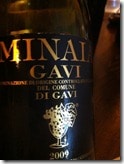
| Wines 1 & 2 we agreed were in the old world. The Gavi di Gavi (ie Gavi from the commune of Gavi not just the DOCG as a whole), Minala 2009, was mid yellow in colour with a gold tint, quite warm on the palate, pleasant apples/pears fruit, balanced. Once we knew we were in Italy, I guessed Gavi. ‘Never more than pleasant’ says Oz Clarke, which is a bit harsh of a wine which can be dull but has some fine examples. | |
| Much more fashionable is the Albariño grape from NW Spain, the Rías Baixas region bordering the Atlantic. Most wines are unoaked, to maximise the Viognier peaches/apricots aromas. But this producer has one barrique for a wine from 100 year old vines right by the sea. Albariño Barrica, Goliardo A Telleira, Albariño Rías Baixas 2009: richness is the key quality, ‘tinned peaches’ someone offers as a tasting note. For me, by the standards of a premium white wine, I am not sure there is quite enough going on. | |
| It was not difficult to spot that this was Riesling – green apples and petrol notes on the nose, high acidity, some residual sugar. Most tasters thought it was new world, perhaps because of its assertiveness. In fact it was Domaines Schlumberger, Kitterlé, 2005, Alsace Grand Cru. The Kitterlé vineyard has perfect exposition getting sun from morning to night, on a slope of 30-60°, with poor and sandy soil, giving concentrated wines from very low yields. The wine was mineral and developing those characteristic petrol notes, a good weight, characteristic-ally fatter than the same grape variety across the border on the Rhine. | |
It was a great idea to bring two wines from the same Meursault-Genevrières vineyard in Meursault, Burgundy, separated by eight years and produced by two different branches of the Jobard family. |
Unfortunately, the Francois Jobard 2000 was suffering badly from that Burgundian disease, premature oxidisation – caramel and cardboard is not an attractive combination. The young wine (Antoine Jobard, 2008) had attractive limy fruit with excellent vitality. |
| A rare moment in this group – a rosé and an unusual one, Harbourne, England, 2001 – and yes that’s not a misprint, it is 10 years old. Slight strawberry nose and then … ‘appears to lack any form of palate’ … ‘made in Scotland?’ ‘grape juice and Irnbru?’. Probably the worst wine we have tasted in this group and brought in jest by one of us who has a limitless supply of unusual bottles. Quite instructive nonetheless – we take fruit on the palate for granted until it’s not there. | |
| Those with eagle eyes will see that the label still tells us that this is Ch. d’Angludet, AC Margaux, 1974. We of course did not know this at the time. A mushroomy nose, a rather sour palate and still some tannins. After about ten minutes some sweet raspberry/ strawberry fruit began to emerge, so it was well worth the wait. Impressive for Bordeaux of this level at this age in a poor vintage – the judgement, ‘mediocre’, from Michael Broadbent is quite kind. | |
| This started with pronounced bottle stink so we parked it for ten minutes. Bottle stink was the consensus, not faulty, just not showing. Eventually some fruit emerged but this wine did not shine. Definitely a disappointment from Mommessin, Santenay, Burgundy, 1993. But there was much better Pinot Noir to follow, not that we knew that. | |
| After the struggles with the last three bottles, this was straightforward pleasure – pale and fragrant and pretty obviously Pinot Noir, but quite weighty and structured. Most went for New Zealand but it turned out to be ‘Knox Alexander’, Au Bon Climat, Santa Maria Valley, California, 2007. Some of the vines are Burgundian apparently, but the wine is definitely from a warm and reliable climate. Time for some food and give the note taking a rest. | |
| Two new offerings from Caviste: Ch. Puy Castéra, Haut-Médoc 2008 and Domaine Cheveau, Saint Amour, Les Champs Grillés, Beaujolais 2010. No notes on either of these – but both good examples of Bordeaux and Beaujolais respectively – I did say I was having a rest from note taking. | |
| For me this was the wine of the evening, pale ruby with a brick red edge, fresh on the nose but with a bit of ageing, violets and red fruit, but then a real vitality on the palate, great elegant tannic structure and fine acidity. I was in Pinot Noir territory thought the ‘pale colour + tannins’ should have pointed me to Nebbiolo: Barolo DOCG, Castiglione Falletto Scarrone, Bava, 2000 To decoded the label: from the Scarrone vineyard of the commune of Castiglione Falletto, immediately east of the town itself. The producer is Bava. | |
| Another pair of wines, the first red, the second for comparison … white. Two young Australian classics just arrived in a very small consignment at Caviste. I don’t think anyone spotted the producer, Spinnifex with its Lola 2010 and Taureau 2008. The former is mainly a Rhône blend – Marsanne, Semillon, Roussanne, Viognier and Ugni Blanc – a really intense wine bursting with energy. The latter is Tempranillo, Graciano, Carignan and Cabernet Sauvignon – Rioja meets South and South West France in Australia? Buy now and do not drink yet! | |
| With this final red, I knew what it wasn’t but not what it was. Ripe fruit, plums and damsons on the palate, deep in colour, rich with excellent acidity. After a few exclusions we agreed on Italy and some wanted to make this Sangiovese. Tuscany was a good guess but not that grape variety – too dark in colour at the very least. In fact it was a Super Tuscan Merlot: Girolami, Castello di Bossi, IGT Toscana, 2001. Late picked Merlot, 28 days of maceration, oak aged for two years – a powerful, forthright wine. | |
| And finally … a sweet wine with a complex nose of apples, caramel, honey, not very acidic but balanced. No real clues here for Stefano Inama’s Vulcaia Aprés Veneto Bianco IGT, Vino Dolce 2001 – being late harvested Sauvignon Blanc (no less), part fermented in acacia barrels and then matured in barrels for 9 months. A suitable climax, and along with the Barolo, a favourite wine of the evening. |