
Is Piemonte becoming a white wine region?
Piemonte is rightly associated with great red wines, especially Nebbiolo. At the same time, it is increasingly in prestige for its white wines made from native grape varieties. For the wine drinker, this is substantiated by the quality of the Cortese, Arneis, Timorasso, Erbaluce and Nascetta produced. However, planting statistics are the ultimate proof that the producers see an important future for white wines. Planting a vineyard is not a short-term option; it shows a genuine belief in the future. This post summarises the changes in the number of hectares planted in the region. It then looks at the trends across the different varieties. The official statistics are available for the years from 2008–2024. As a result, they give a picture of the changes over the last decade and a half.
The size of the total vineyard area in Piemonte reduced by 6.9 per cent in this period from 44,795 to 41,699 hectares (ha). This was mainly due to the drop in demand for basic red wines. The market has shifted from wine as an everyday staple to wine as a discretionary choice in a consumer economy. Disease has also played its part. Barbera, Piemonte’s most planted variety, is very susceptible to vine yellows (flavascenza dorata).
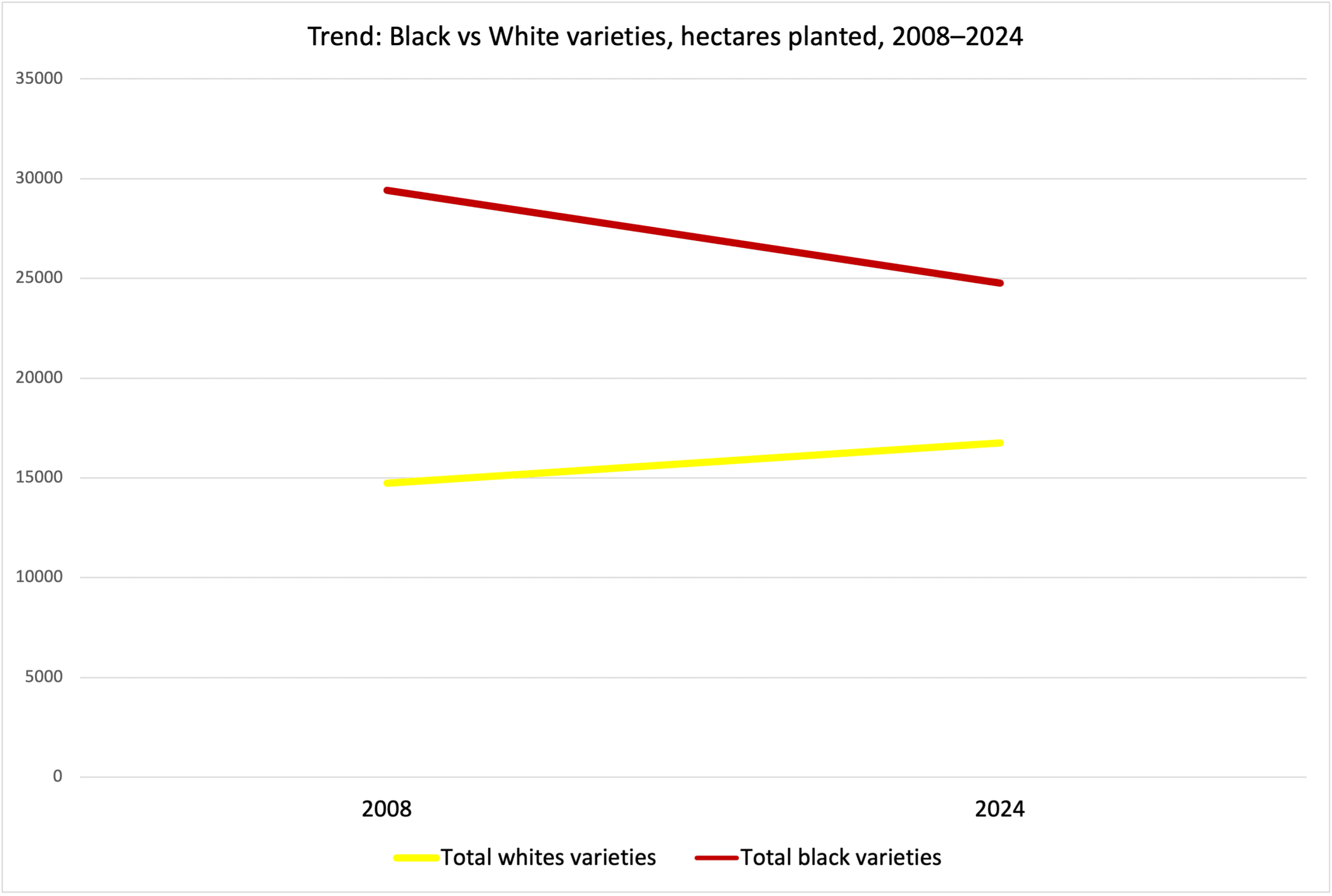
In 2008–24, the hectares planted of black varieties fell by 16 per cent. At the same time, those of white varieties rose by 14 per cent. As a proportion of total plantings, white varieties increased from 33 to 40 per cent, while black varieties were reduced from 67 to 60 per cent. Thus, the overall plantings suggest that Piemonte is becoming a white wine region or at least one in which white wine production is increasingly important.
Black varieties: the big three continue to dominate
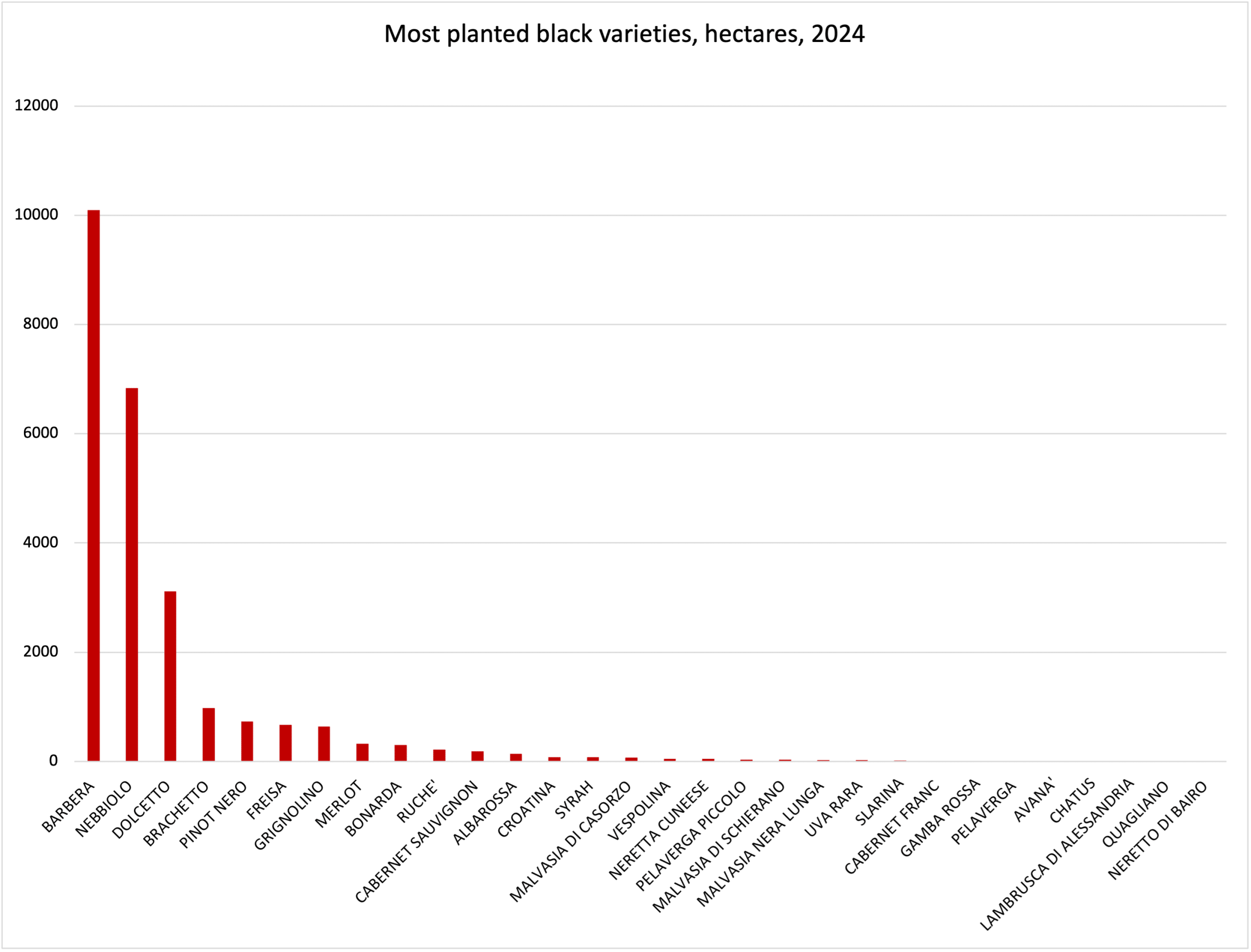
Barbera with 10,099 ha continues to be the most-grown black grape variety. It accounts for 3,000 more hectares than Nebbiolo with its 6,835 ha. The latter is now Piemonte’s second most-grown black variety. Dolcetto now comes third and a long way back with 3,115 ha. Although Nebbiolo is Piemonte’s most valued variety, it was only in 2015 that it overtook Dolcetto in terms of hectares planted. However, what is truly remarkable is the rapid changes in the hectares devoted to the top three varieties. And it is worth remembering that these changes have taken place in the context of an overall reduction of hectares of black varieties.
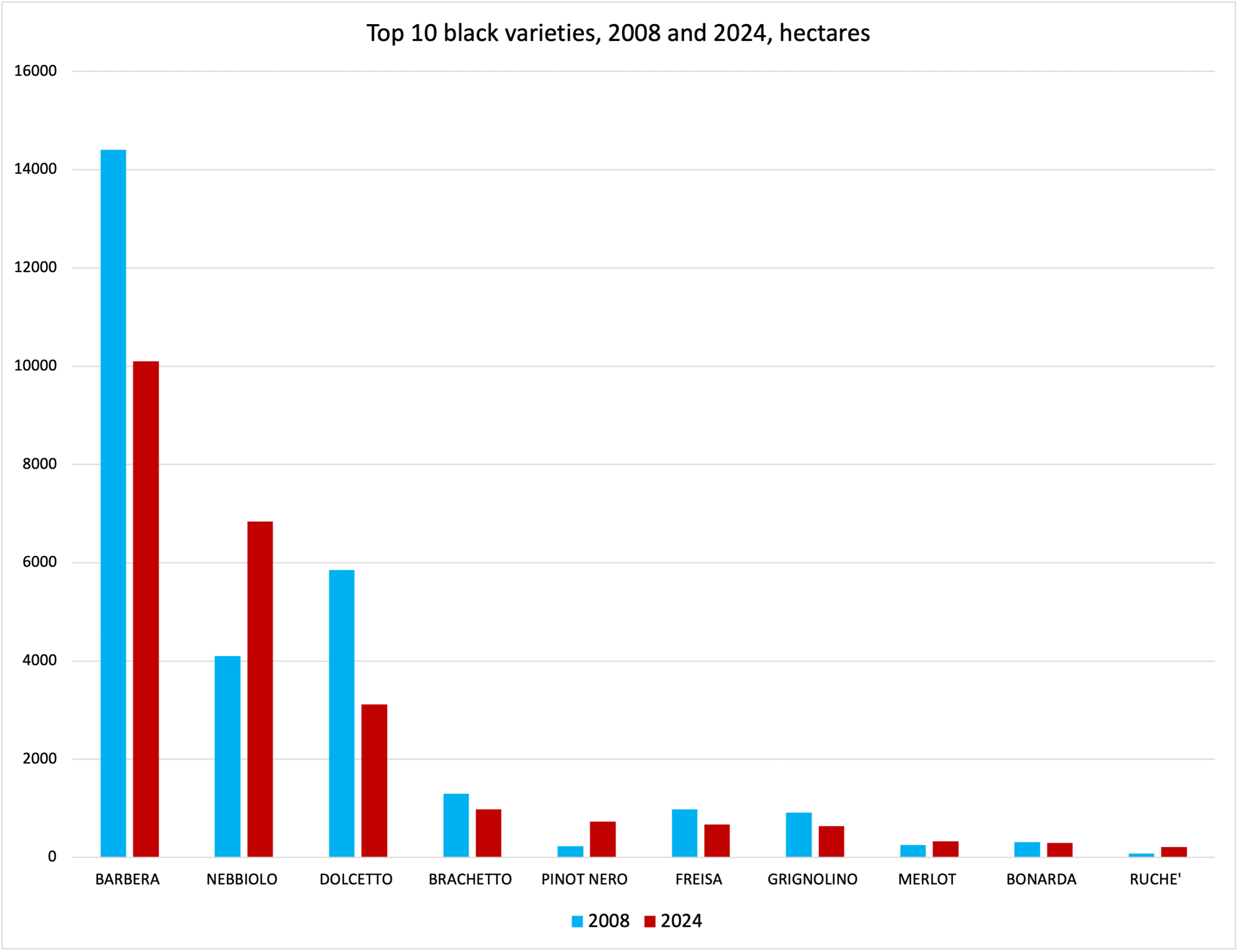
Nebbiolo on the charge, Barbera and Dolcetto in retreat
Nebbiolo plantings have increased rapidly from 4,100 to 6,835 ha, a growth of 67 per cent. I discuss the ‘Nebbiolisation’ of the Langhe in detail in chapter 4 of my book, The Wines of Piemonte. Seventy per cent of the additional hectares are in the Langhe but Monferrato and Alto Piemonte also contributed. This will be the subject of a further post.
Barbera was the rising star in the nineteenth and early twentieth centuries. It was favoured by growers as it was easy to grow, would ripen on a range of sites and could produce high yields. However, as noted, less of it is grown today. Barbera declined by 30 per cent in the last decade and a half. It still claims the most hectares under vine in Piemonte at 10,099 hectares. However, if it continues to decline it may soon lose that accolade to Moscato Bianco which is only 266 ha behind it.
Only Dolcetto has performed worse in the same period, declining by a massive 47 per cent to 3,115 ha. It has been hit by changes in consumer behaviour and by the value of Nebbiolo. For example, Dolcetto was the everyday wine of the Langhe in the past, but that is no longer the case. In the Langhe in particular, many Dolcetto vineyards have been replaced by Nebbiolo. In addition, it now comes a very poor third to Nebbiolo and Barbera in terms of marketing priorities. Further, there has been no Piemonte-wide initiative to promote Dolcetto which currently is represented by no fewer than 10 denominations. This fragmentation does not serve the variety well, especially as it undeservedly picked up a reputation for poor quality. Just because Dolcetto is not Nebbiolo, does not make it a bad wine.
Black varieties, other trends
The other notable trends in the last decade and a half are the increases in Pinot Noir and Ruchè, two very different stories, and the reductions in Brachetto, Freisa and Grignolino. Pinot Noir has seen increased plantings of 505 hectares, more than doubling its plantings to 735 ha. The increase is partly due to the Piemontese trying to grow the grape for still wine just like growers around the world of wine. But about a third of the plantings (263 ha) are destined for Alta Langa DOCG, Piemonte’s rapidly growing traditional method sparkling wine. The growth of Ruchè, now 214 ha, is a heartening story of a minor variety being increasingly grown. It has been championed in particular by Luca Ferraris and Montalbera. By contrast, it is sad to see the reduction in the plantings of the characterful Grignolino and Freisa, and the decline of Brachetto. The last named makes a delightful sweet, low alcohol, sparkling wine, a red Moscato if you will but is no longer in demand. In 2024, it became the red component in the new Asti Rosé category but we will have to wait to see if this catches on.
White varieties: Moscato continues to reign
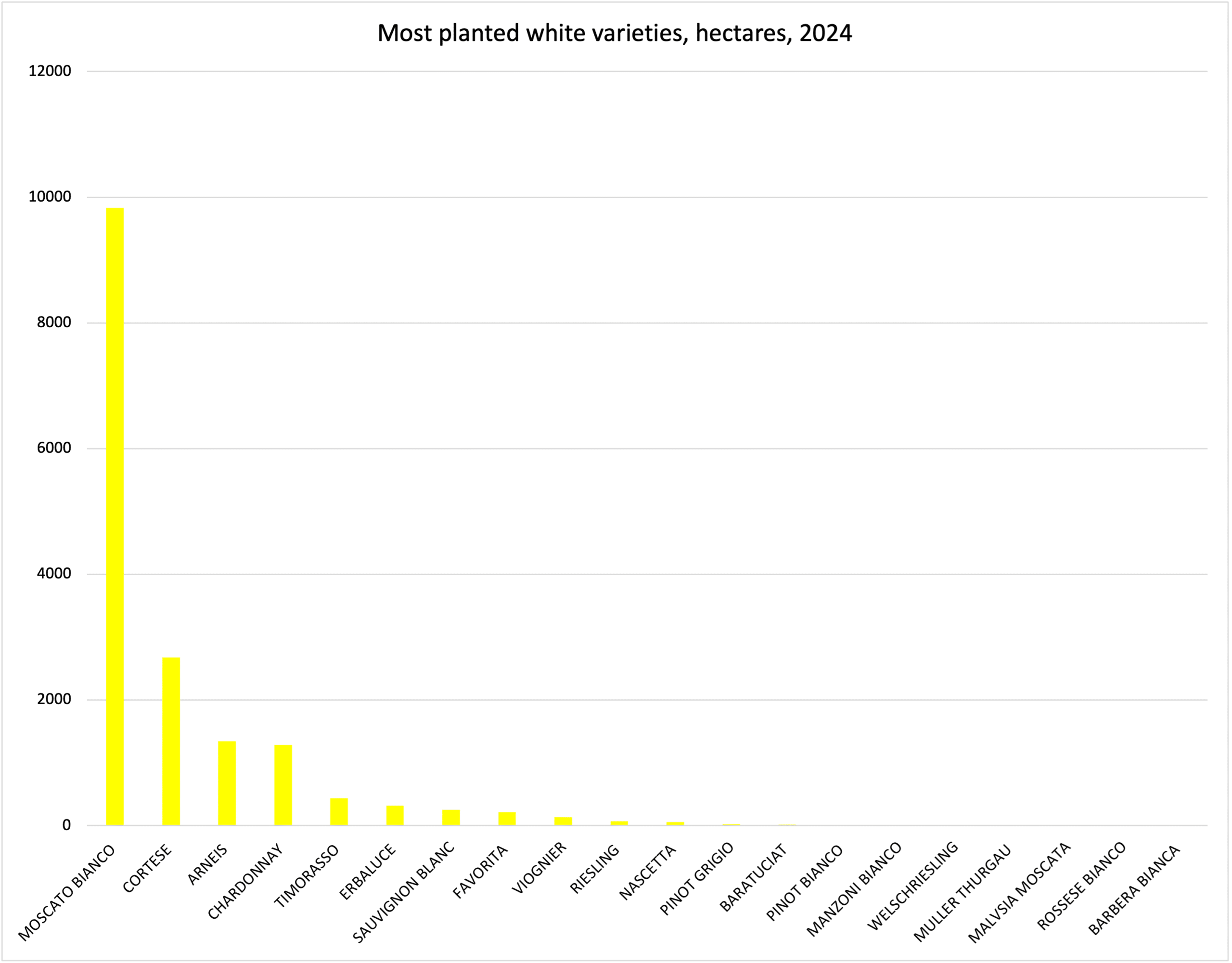
Moscato is the uncontested king of the white wine varieties in Piemonte in terms of hectares planted. With 9,833 ha, it has more than three times the plantings of number two, Cortese. In the context of an overall reduction in plantings, it is the same size as a decade and a half ago. Moscato is trailed by three varieties with more than 1,000 ha. Cortese has 2,680 ha, of which 1,594 make Gavi DOCG, Arneis has 1,346, of which 922 make Roero Arneis DOCG, and Chardonnay has 1,286. Most of the last named is Piemonte Chardonnay, 663 ha, or Langhe Chardonnay, 342 ha.
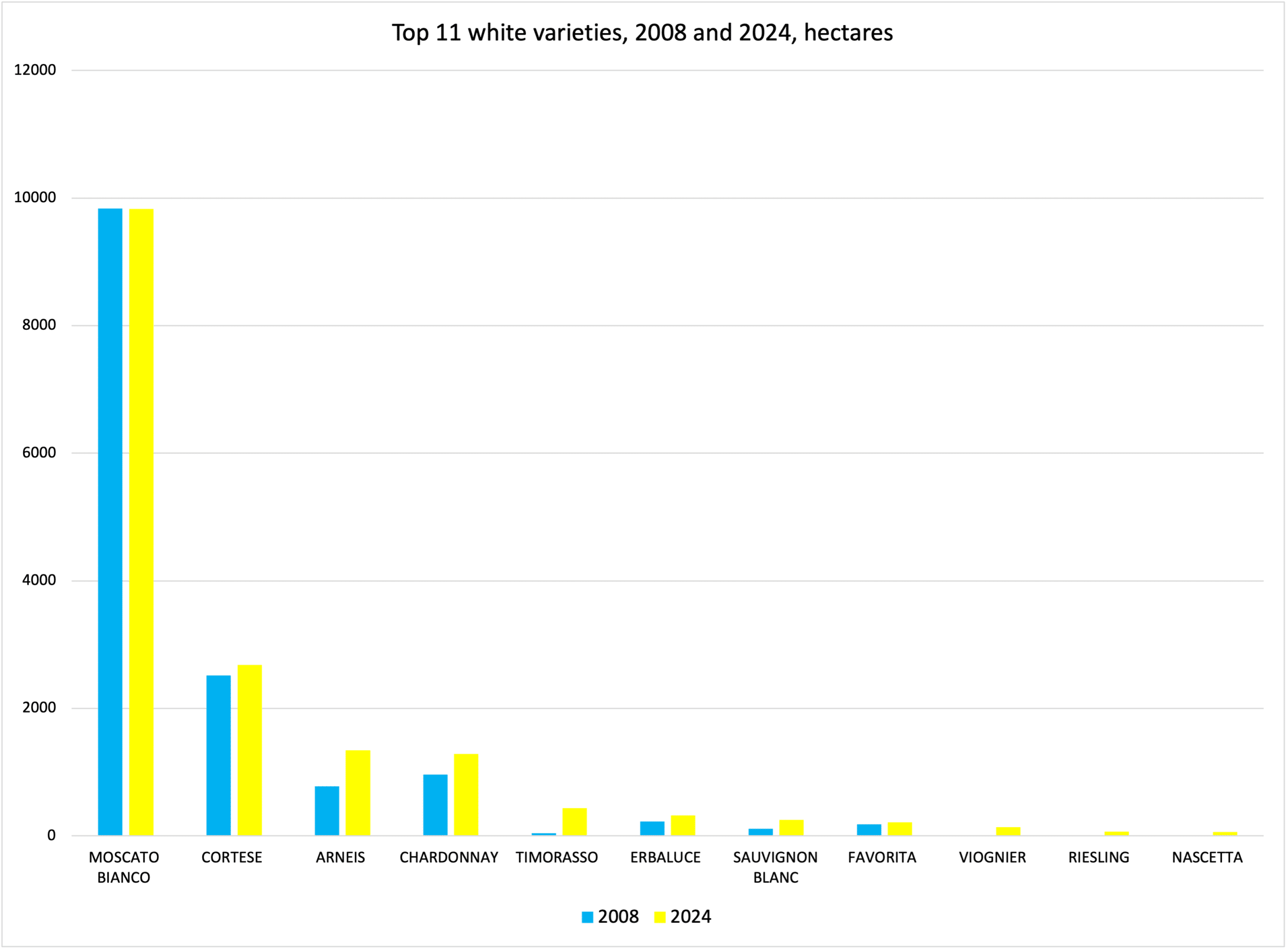
Trends in white varieties
The major white varieties have not seen dramatic changes in contrast to the black varieties. The trend is that, apart from the commanding Moscato which has maintained its numbers,4 they have all increased. Arneis has risen by 569 ha to 1,346 and Chardonnay by 322 to 1,286. Cortese has nudged up by 163 ha to 2,680. Timorasso is clearly the rising star. From a base of just 45 ha, it has now been planted on 439 h (397 in the Colli Tortonesi). Interestingly, while Nascetta has attracted much attention, it has not seen the same increase. From a tiny base of just 6 ha, it now stands at 60. Of these, 40 ha make Langhe Nascetta and 14 go into Langhe Nascetta del comune di Novello. The significant increases in the top white grapes planted show that Piemonte is becoming a white wine region.
Erbaluce (+95 ha to 322), Sauvignon Blanc (+141 to 253) and Favorita (+29 to 214) plantings have increased. The two international varieties are beginning to be seen. Viognier grew from 1 to 137 ha in the last decade and a half while Riesling increased from 1 ha to 71. Why does the chart show the top 11 varieties? To include the fashionable but not much planted Nascetta which comes in as the eleventh most planted white variety.
All in all, there are two large trends in Piemonte. More and more Nebbiolo is being planted for obvious commercial reasons and mainly at the expense of Barbera and Dolcetto. Growers have increasing confidence in Piemonte as a white wine region, as a complement to their red wine offerings. With forty per cent of the hectares in Piemonte now dedicated to white varieties, it can be said that Piemonte is becoming a region of both red and white wines.
This article was first published in Decanter magazine, April 2025 and was the basis of a masterclass I led at Vinitaly International, Verona, in collaboration with Decanter.
