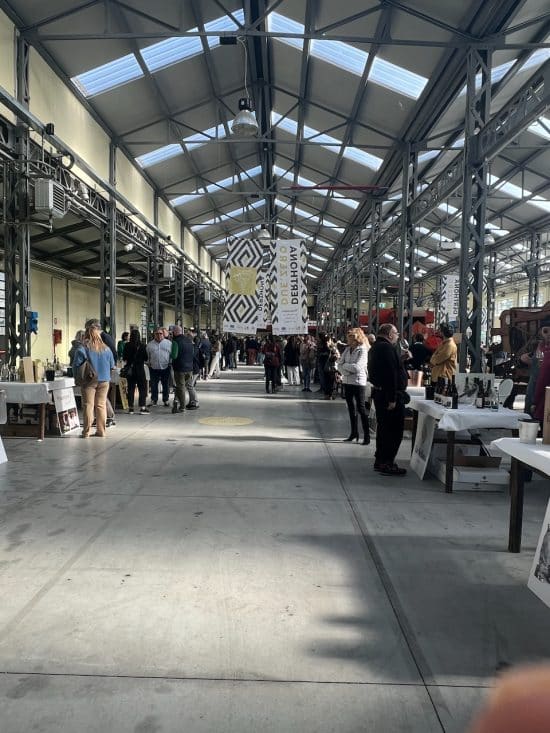
In March 2026, I had the pleasure of attending a press trip to Tortona, alongside the public tasting Derthona DueZero, a celebration of the Timorasso grape variety and the wines of the Colli Tortonesi. Early spring days, committed growers and winemakers, great hospitality and the charm of Tortona itself made for an informative and thoroughly enjoyable visit to eastern Piemonte. In short, Timorasso updated.
The Timorasso planting surge
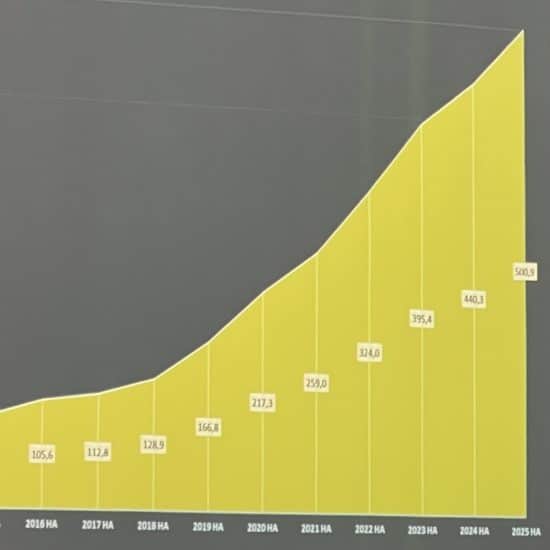
The recovery of the Timorasso grape is now a familiar story. Walter Massa’s pioneering wines and tireless advocacy paved the way. In turn, this prompted Barolo and Barbaresco producers to invest in plantings in the Colli Tortonesi, nearly an hour and a half away. Local growers have followed suit. What is less widely appreciated, however, is the sheer scale of this expansion. From just 0.5 hectares in 1987, plantings reached 3 hectares by 2000, before rising steadily to 106 hectares by 2016. Growth has since accelerated dramatically, increasing almost fivefold to 500 hectares by 2025. Historically, the most widely planted variety in the Colli Tortonesi has been Barbera. On this trajectory, Timorasso is likely to overtake Barbera as early as 2026.
What is driving this growth?
Several factors are at play. First, the intrinsic quality of the wines, coupled with growing praise from external commentators, has given producers increasing confidence in the variety’s potential. Second, Timorasso offers something particularly attractive to estates in Barolo and Barbaresco. It offers the opportunity to produce a white wine with genuine ageing capacity, aligning with their established focus on ageworthy reds. Third, the availability of land is a practical consideration. While suitable vineyard sites in the Langhe are now scarce, the Colli Tortonesi still offers opportunities. Finally, there is the broader context of rising global demand for white wine. As one successful Barbaresco producer recently remarked to me, clients are increasingly approaching them—even in Barbaresco—specifically in search of white wines.
A broad church
Tasting the 2023 and 2024 vintages
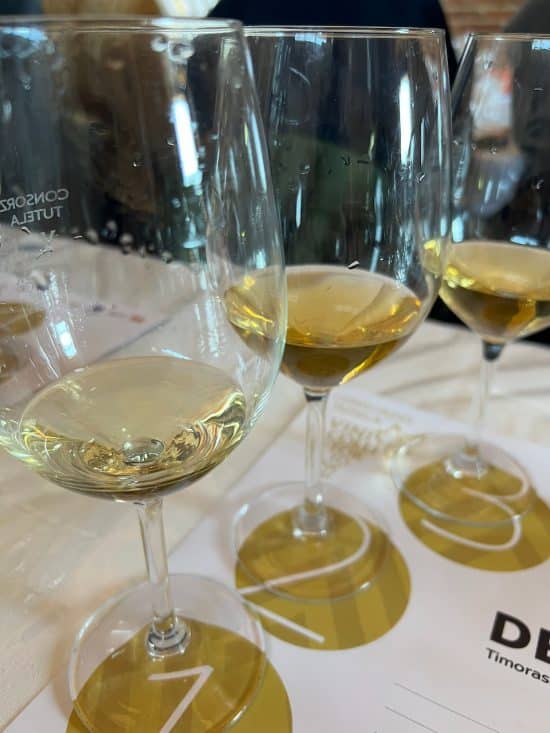
The 2023 growing season can be summarised succinctly: a wet spring followed by a hot second half of the year. Mildew pressure was a concern early on, but most producers were well equipped to manage it. The resulting wines show generous ripeness, with peach and apricot fruit to the fore, alongside the variety’s typical stony and lightly herbal nuances. Despite the warmth of the latter part of the season, balance was well maintained, with Timorasso’s naturally high acidity providing freshness and drive. Overall, quality is high and notably consistent across the denomination. Standout wines were produced not only by leading names such as La Colombera, Vigneti Massa and Vigneti Repetto, but also by Cascina Gentile, Davico Stefano, Mandirolla Enrico, Ricci, Romanzo del Vino and Valleunite.
The 2024 season was widely described as challenging, with persistent rainfall throughout the growing cycle and, crucially, during the harvest period. Mildew pressure was significant, and many producers reported losses of 30–50% of their crop. Unsurprisingly, the wines show considerable stylistic variation. Some are lean and green-edged—though it should be noted that even fully ripe Timorasso can display camomile-like notes—while others are markedly riper. In certain cases, acidity feels overly prominent. Much of this variation appears to reflect differences in picking strategy. Some growers harvested early to avoid further rain, while others waited for drier windows. The latter may have achieved greater ripeness, but often at the cost of increased losses to rot. Those who undertook strict early selection, discarding damaged fruit, were in some cases rewarded with lower yields but better ripeness.
Who would be a grape grower? Despite the difficulties, excellent wines were produced by Boveri Luigi, Cascina Giambolino, Davico Stefano, La Colombera, Mandirolla Enrico, Mariotto Claudio, Oltretorrente, Paolo Poggio, Ricci and Vigneti Massa.
It’s not just about Timorasso
For all the well-deserved attention given to Timorasso, it is easy to overlook the broader range of grape varieties grown in the Colli Tortonesi. This is particularly the case for grapes for red wines. Historically, Croatina, Freisa and Barbera have all played important roles, and they remain widely planted today, with Barbera especially prominent.
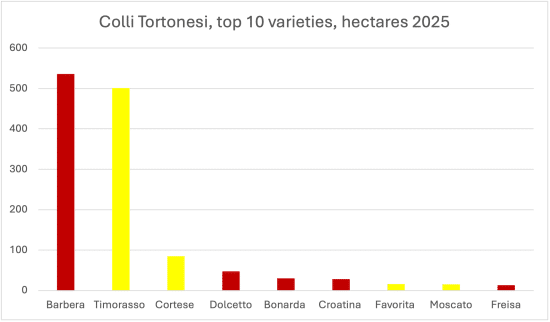
While the formal Anteprima focuses exclusively on Timorasso, the walk-around tasting offers a fuller picture. It allows producers to present wines from across their portfolios. Here, Barbera stands out as the leading red, with the Monleale subzone dedicated specifically to it.
There is also interest in Croatina and Freisa, both capable of producing deeply coloured, structured wines. These can be compelling examples—provided one appreciates their bold tannins and a degree of rustic character.