
Piemonte's vineyards, two years on: a dramatic moment
Vineyards change slowly, or at least that is the assumption most of us make: a vine planted this year will not give a proper crop for three seasons and will not be judged mature for a decade, so two years feels like too short a window for anything to have moved much. When I wrote about Piemonte’s evolution towards becoming a red and white wine region, I used hectare figures from the Regione Piemonte vineyard register covering 2008 to 2024. I expected the next update to be some years off. But the register now has 2026 figures too, and the trends I described are continuing — with one genuine surprise.
Piedmontese vineyard shrinks for the first time since 2009
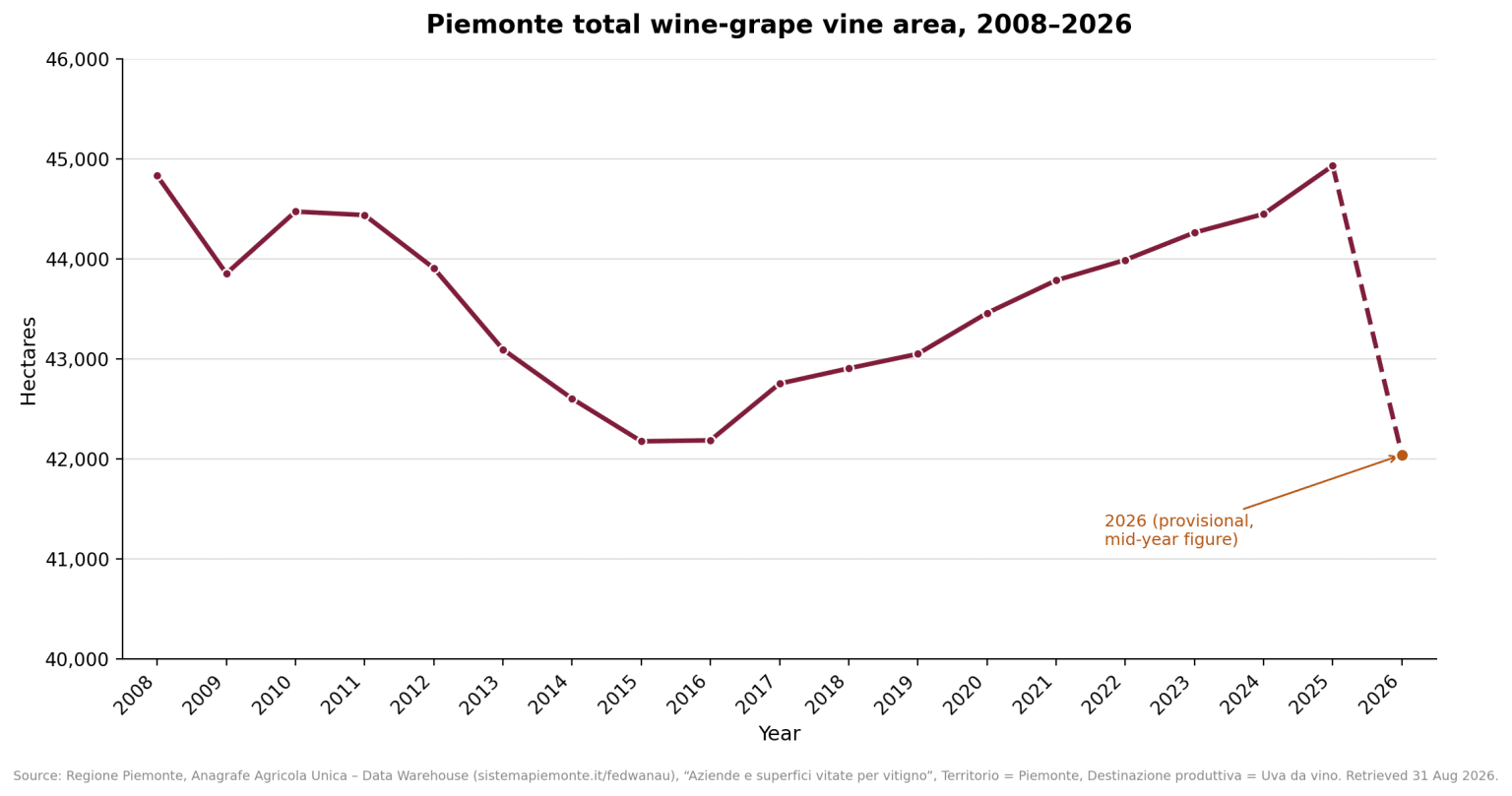
The world’s vineyard area is shrinking, driven by decades of overplanting running up against falling demand. Global wine consumption in 2024 was down 14 per cent on its 2007 peak. Land under vine fell by 7 per cent over the same period (OIV data), with further reductions planned, especially in Europe. Piemonte’s story has been more mixed. After the 2008 financial crisis, vineyard area contracted steadily between 2011 and 2015, but then grew again, and by 2025 had actually surpassed the 2008 figure, if only marginally. The preliminary 2026 figures, however, show a sharp reversal: the total area has fallen to around 42,000 hectares, a drop of nearly 3,000 hectares — 6.4 per cent — in a single year.
The reasons behind this reduction seem to be multiple:
- full cellars, reflecting overproduction in recent years
- sharp reductions in grape prices for those who sell to bottlers, halving the price for grapes, including for Barolo and Barbaresco
- hail damage becoming a repeated pattern
- late payment for grapes sold in the previous year
- at the same time, land prices continue to rise.
- rising costs of diesel, energy and agricultural products
- American tariffs and reduction of sales to Russia (a key market for Asti), plus war in the Middle East
Source : La bolla del vino: perché in Piemonte ormai si lavora in perdita (InfoSannio, 15 June 2026)

Barbera and Moscato: the crown is nearly changing hands
A striking number in the new data is the virtual closing of the gap between Piemonte’s two leading varieties. In 2024, Barbera still led Moscato Bianco by 336 hectares (10,762 ha against 10,426 ha), a comfortable enough margin. By 2026 that gap had closed to just 48 hectares (9,897 ha against 9,849 ha), with Barbera down 8.0 per cent and Moscato down a slightly gentler 5.5 per cent. Both held roughly steady through 2025, then fell in the 2026 figures — Barbera by more than Moscato — and at this rate, Moscato Bianco looks set to overtake it as Piemonte’s most planted variety within the next year or two. Given that Barbera’s lead over Moscato was over 4,500 hectares back in 2008, this is not a sudden reversal as much as the last stage of a very long-running one.
Nebbiolo’s climb pauses, Dolcetto’s decline accelerates
Nebbiolo’s rise has been the other defining story of the last two decades in Piemonte, up 67 per cent between 2008 and 2024 on the figures I used last time. That climb appears to have paused: Nebbiolo area actually fell slightly between 2024 and 2026, from 7,313 to 7,192 hectares, a modest 1.7 per cent decline. It is much too soon to call this a turning point, and two years of data is a thin basis for reading anything into a single dip, though it is at least worth noting that even Nebbiolo is no longer simply on the up.
Dolcetto’s decline, by contrast, has clearly sped up rather than slowed. Between 2008 and 2024 it fell by 47 per cent over sixteen years; between 2024 and 2026 alone it fell a further 13.3 per cent, from 3,308 to 2,867 hectares. Annualised, that is roughly double the pace of the longer-term decline, and Dolcetto now sits at barely a fifth of Barbera’s area, a long way from the ‘big three’ status it held not so many years ago.
Timorasso and Viognier continue to climb
Away from the top of the table, the varieties I flagged as the interesting growth stories in the earlier piece have mostly carried on in the same direction. Timorasso, the clearest revival story in Piemonte, is up another 17.2 per cent in two years (478 to 560 hectares) and continues to pull away from Erbaluce, which fell 13.3 per cent over the same period to 324 hectares. Arneis (+4.6 per cent) and Pinot Nero (+6.4 per cent) both grew modestly, while Ruché overtook Favorita in the rankings on the back of a small gain of its own. Viognier is the real outlier: up 22.7 per cent in just two years, from 151 to 185 hectares, the largest percentage increase of any variety in the top twenty.
Brachetto had the roughest two years of any established variety, down 15.5 per cent, and Cabernet Sauvignon fell 12.1 per cent, continuing a decline that goes back to 2008. Chardonnay and Sauvignon Blanc were both essentially flat, which, after years of steady growth, is itself a small shift in their story.
Fewer, larger farms
In my earlier piece, I did not discuss the number of farms (aziende) growing wine grapes in the region. Piemonte had 19,000 wine-grape farms in 2008, and that number had already fallen to around 10,500 by 2024 — a decline of nearly 45 per cent in sixteen years, even as total area barely moved. Against that backdrop, the 2024-to-2026 numbers look like more of the same trend rather than a break from it: the number of farms fell by 14.6 per cent. That gap shows up as a rise in average holding size almost everywhere: the average Barbera grower now farms 1.90 hectares of it, up from 1.67 two years ago; the average Moscato grower is up from 3.25 to 3.72 hectares; Nebbiolo from 2.01 to 2.27. Erbaluce lost farms fastest of all, down 29.3 per cent against a 13.3 per cent fall in area, suggesting a real thinning-out of small growers rather than simple consolidation. Put alongside the 2008 baseline, though, what looks like a sharp two-year squeeze is really the latest, and not even the steepest, stretch of an eighteen-year contraction in the number of businesses growing Piemonte’s grapes.
Trend from dominant red to red and white continues
Piemonte’s move from a red-dominated region towards a more balanced red-and-white one is not a recent development but a trend that has held steady over the full eighteen years since 2008. Back then, white varieties covered a third of the region’s vineyard area, a 33:66 split. By 2026 that had shifted to roughly 17,200 hectares of white and 24,600 hectares of red, or about 41:59. Vineyards planted to white varieties grew by around 17 per cent even as total plantings edged down, while those planted to red varieties fell by around 16 per cent.
Sources:
Regione Piemonte, Anagrafe Agricola del Piemonte
