
A hundred years ago, there were some 40,000 hectares of vineyard in Alto Piemonte. Today the figure is a tiny fraction of that, with 650 hectares of Nebbiolo registered in 2025 and less than 15 hectares in the Ossola Valley. However, if you spend an afternoon in the Val d’Ossola, you can discover that there is also a newcomer who believes in the territory.
Janet and I arrived at DEA on 11 September, having been invited earlier by Francesco Stratta: “If you’re in the neighbourhood, come.” We extended our stay in northern Piemonte, where we had been on holiday on the lakes, to visit Domodossola. Later we learnt that, by good fortune, we had also missed the air traffic control failure at Gatwick. We spent a few hours walking the vineyards close to the Vigezzina railway line with Francesco, one of the brothers behind this young, multi-product estate: wine, honey and saffron.
Who DEA is
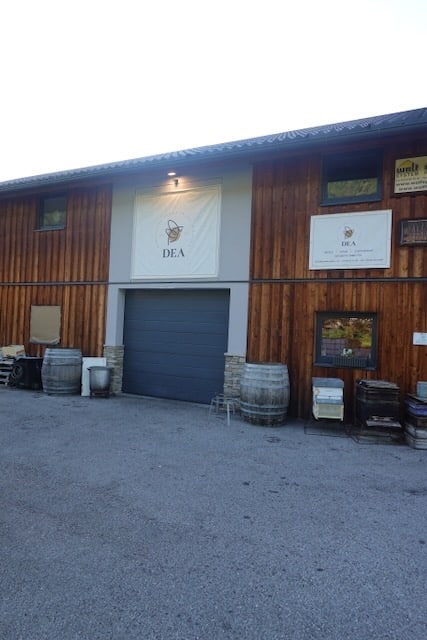
DEA – or DEA Agricoltura Eroica in Val d’Ossola to give it its full name – is not, by Francesco’s own account, one of the long-established family names of the valley. He and his brothers – Paolo, the youngest, and an older brother who lives in Vienna – come out of the building trade, supplying windows, doors and flooring across the Domodossola area. That business is partly sold, partly still running at reduced scale now that the vineyards take most of their time. The move into wine began around 2018, properly formalised as DEA in 2021. They also produce honey (160-170 hives, tended mainly by Francesco’s nephew Emanuele) and a small plot of saffron grown on the sandy valley floor at Masera.
Francesco stated that the name is not an acronym, whatever people assume. It was chosen simply as a word worth remembering, standing for the wider project – nature, landscape, history – rather than any one product.
The three brothers do most of the pruning themselves (he reckoned 95% of it falls to him and Paolo). They learnt through a proper course in the Simonit & Sirch method and an agronomy course with Giovanni Bigot. Michele Colombo, the local growers’ association’s agronomist, is on call when needed. It is, in other words, a family finding its way back to the land with a commitment to learning, rather than inheriting a way of doing things.


The vineyards
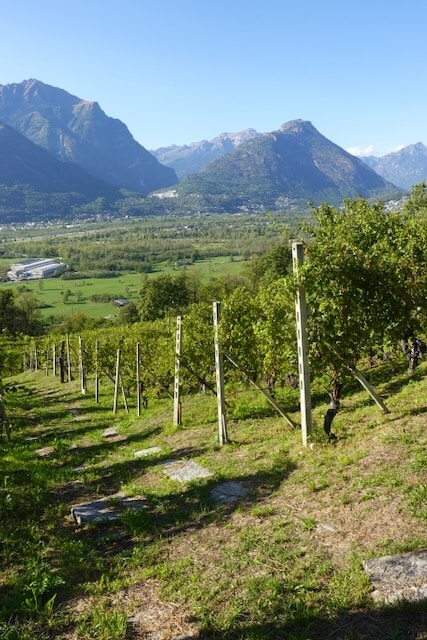
DEA’s fruit comes from two main sites – Fomarco, at the mouth of the Val Anzasca beneath Monte Rosa, and Trontano, at the mouth of the Valle Vigezzo – together with perhaps ten smaller plots, several taken on from older growers no longer able to work them themselves. This is the same pattern Marco Garrone had described to us only the day before. Between the main holding of around 1.6 hectares and the smaller parcels, the total comes to something over two hectares. The soils are largely morainic, the legacy of a retreating glacier, running to clay and stone on the slopes and to near-pure sand down on the valley floor, where the saffron is planted.
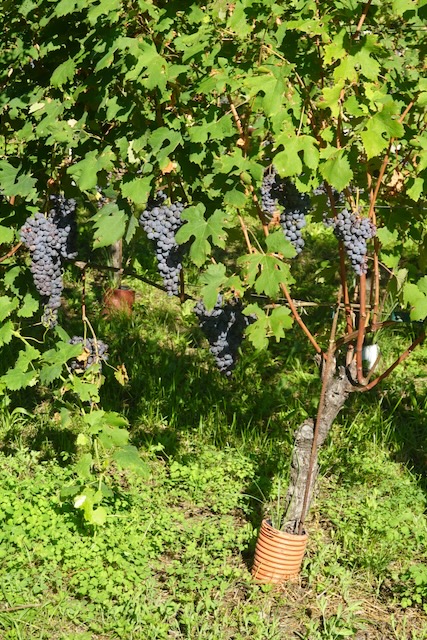
Both Guyot and the traditional pergola (toppia, supported on dry-stone pillars and chestnut beams) training systems are used. Francesco was clear about the trade-off between them. The pergola asks more of the pruning and less of the leaf-stripping, since the fruit hangs below the canopy rather than needing to be exposed to the sun. It also offers some protection from hail. Foxes and badgers cannot reach the fruit, but deer can still browse at the margins. See the picture above. Guyot, by contrast, needs two separate rounds of de-leafing each year to keep downy mildew at bay in a valley that holds humidity readily, oidium being, in his words, ‘a bad enemy here’. A hailstorm on 10-12 August this year caused some damage. However, it fell with rain and did less harm than it might have; the pergola-trained vines came through largely unscathed.
Research projects
Impressively for such a small winery, two research projects run alongside the farming itself:
- a clone-selection trial (the ‘Rauscedo‘ project), now in its third or fourth year, micro-vinifying different Prünent clones to decide which to propagate;
- a drone-spraying trial with the University of Turin, comparing treatment by drone against the traditional hand-carried approach over a 500 square metre plot.
Harvest, in any case, remains entirely manual, in 16-18kg crates, on ground too steep in places for a tractor to reach.

The wines
Two wines are made, both based on Prünent, the valley’s own biotype of Nebbiolo, first documented in a bequest of 1309. Archè 2023 is a blend, 80-85 per cent Prunent with the remainder being Croatina, Barbera and a little Merlot. The last-named is a historical presence here, perhaps a legacy of the valley’s old trading links across to Ticino. The wine is matured entirely in steel and sits at 12.5% abv, with around 2,500 bottles made. Proodos 2023 is 100% Prünent, aged for a year in two 2,000-litre Austrian oak casks from Klaus Pauscha before a further nine months in bottle. Roughly 5,500 bottles are made.
The choice of cask was deliberate, and Francesco returned to it more than once: a fine-grained oak, medium-low toast, chosen specifically so the wood would not overwhelm the fruit – ‘we didn’t want to cover the wine’. It is a small but telling decision for a four-year-old producer still settling on its own house style.
A valley renewing itself
Valli Ossolane only became a DOC in 2009, and DEA has been making wine for barely four years of its short existence. Set against 40,000 hectares a century ago and a national picture of growers giving up small plots, it would be easy to regard it as marginal. But what struck me walking the slopes with Francesco was less the smallness of the project than its commitments – the courses taken, the casks chosen with real care, the research projects, the reclaimed plots taken on from growers too old to work them. Who would be a grape grower in difficult times, taking on a hillside like this from scratch? Evidently, in the Val d’Ossola, there are still some impressive people willing to try, convinced about the importance of the land and the quality potential of Prünent. I have no doubt that DEA has a strong future and will contribute to the revival of viticulture in the Ossola Valley.
For my reviews of Dea wines, see the 2026 Northern Piemonte report, available as a free download here.
